


What does the Finnish theatre offer a multilingual audience? “Subtitles alone are not enough”
Premiering at the National Theatre, Hautakivi raises the question of how theatre should reach out to new audiences and what language should be used.
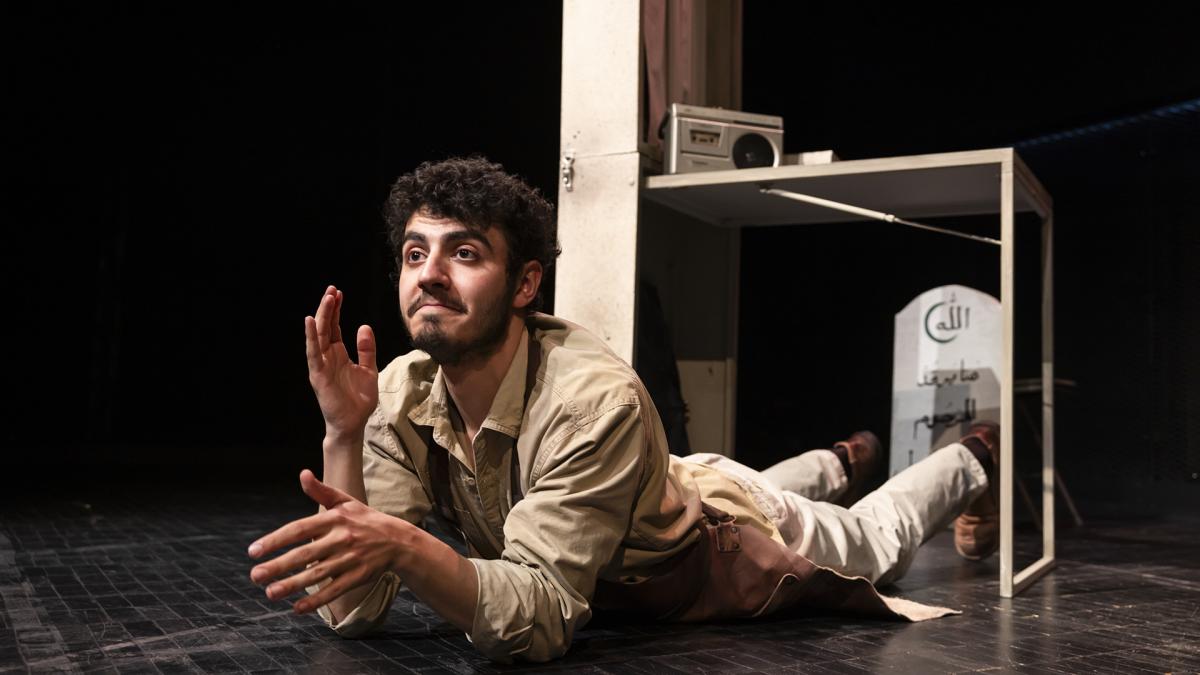
On the rehearsal hall stage, a young man stands right at the edge of the front row, gripping a wooden club. Strength is evident in his hands, carried through his stance. If a person was sitting in the front row, they might feel a little nervous, perhaps thinking: Are they really going to be standing that close?
“This is the Arabic version of Hautakivi,” says director Hassan Alssaleh, and asks actor Youssef Asad Alkhatib to act out the scene with a Finnish touch.
Alkhatib takes a few steps back.
“It’s not only about the language of the performance, but also about culture, about how close to the audience you can be so that the message comes across the right way and the connection remains natural,” Alssaleh explains.
“The story doesn’t change. The theme is human and honest and comes through regardless of language.”
New storytellers
Hautakivi is the artistic thesis project of Alkhatib, who studies at the Theatre Academy, and it is written and directed by Alssaleh. They developed the Arabic and Finnish versions in parallel for a long time, with the intention of staging both.
In the end, however, the decision was made not to produce performances in Arabic. Although the language of the performance ended up being only Finnish, the work still takes a stand on who is allowed to tell stories of people with immigrant backgrounds in Finnish theatre and on what terms.
“I don’t want to be just an object that other people describe but take action and actively contribute to the stories of people with immigrant background that people see on stage,” Alkhatib says.
Hautakivi centres on a Syrian refugee called Saber, who arrives to Finland with his brother’s gravestone.
“A similar story can’t be written credibly by someone who has lived their whole life in Espoo. Not even if they were an exceptionally skilled writer,” Alkhatib says.
Theatre can build a stronger sense of belonging
Alssaleh and Alkhatib are both originally from Syria and their first language is Arabic.
“While living in Finland, I have directed productions in Finnish and English. It hasn’t been my particular goal to make non-Finnish-language theatre,” Alssaleh says.
He still believes that if the aim is to reach people, you have to speak the audience’s language.
“In the capital region alone, there are tens of thousands of Arabic speakers who aren’t catered to at all by Finnish theatres.”
Saana Lavaste, professor of directing at the Theatre Academy, recognises the problem.
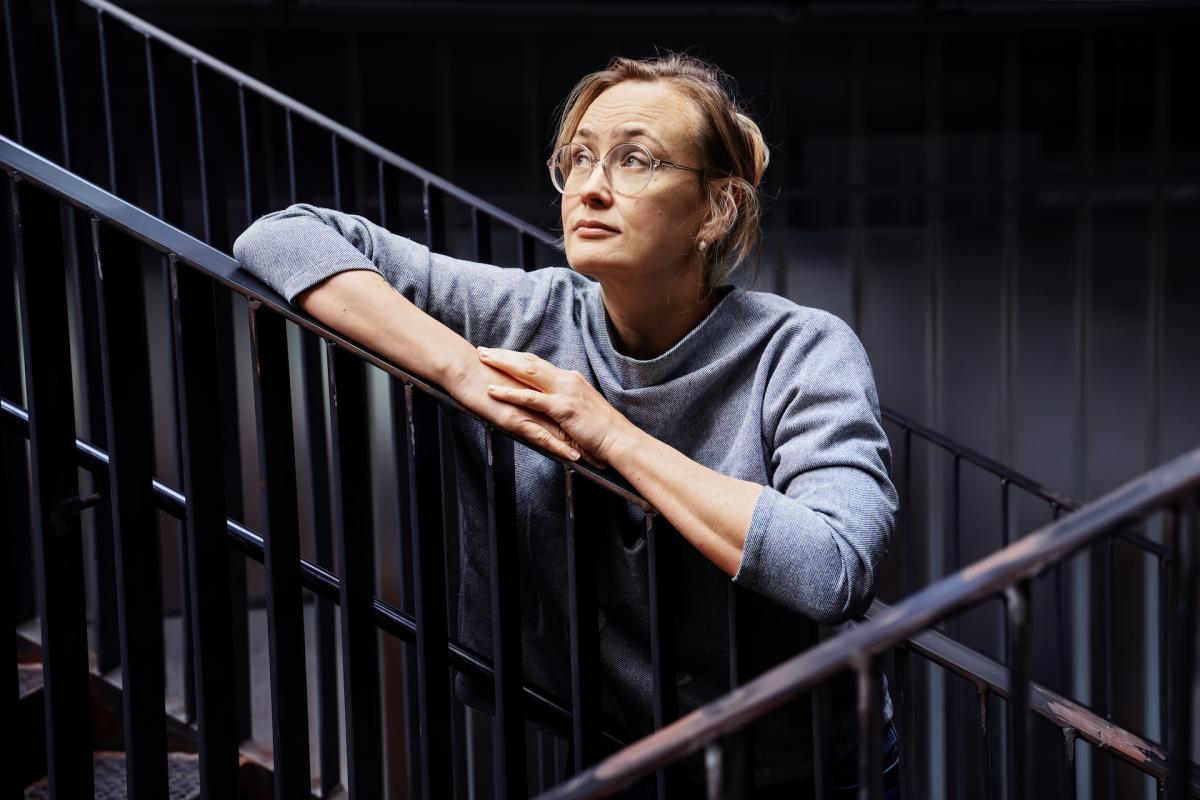
“Theatre should be a place that builds a sense of belonging. If we view the audience as exclusively Finnish or Swedish speakers, a large part of the group of potential theatre-goers is left out,” she notes.
There has been a clear change in the population. For example, a statistical forecast by the City of Helsinki Executive Office shows that by 2030, Uusimaa will have almost 400,000 residents whose first language is not Finnish or Swedish.
However, merely subtitling performances or introducing new performance languages is not enough.
“When we say we want to see change, we’re also talking about content and structures. We want to expand ideas on who is allowed to tell stories and from what perspective.”
Multilingualism has potential
Change within the arts sector remains slow and is often met with resistance. Historically, language has been a political issue in Finnish theatre, and it is still a sensitive topic.
Funding is already scarce, and it is often used to promote “Finnish culture”, which pushes other languages to the margins.
As a result, multilingualism is mainly promoted through individual projects, something Alkhatib has experienced firsthand. He finds these kinds of projects important, but at the same time, they evoke mixed feelings.
“I’ve felt like a Christmas tree that is brought out for a while and then taken back into storage.
Opening the door once is not enough. It needs to be actively kept open,” he says.
Lavaste points out that the use of various languages also offers artistic possibilities.
“Theatre director and researcher Vanja Hamidi Isaacson suggests that multilingualism can create parallel layers of meaning in a performance and highlight a broader range of perspectives. The audience doesn’t need to understand everything in order to experience and engage with the story.”
The goal is thriving art
Uniarts Helsinki has become increasingly international in recent years. To name a few examples, having Finnish skills is not a requirement in the Theatre Academy’s admissions to the Master’s Programme in Directing, and the aim in the entrance examinations for acting studies has been to broaden the notion of what an actor can be like.
The goal is to introduce more accurate representations of Finnishness on stage so that they reflect our changing reality.
Lavaste believes that the increasingly international Uniarts Helsinki is reshaping the field. However, students are not specifically guided towards multilingualism or audience-oriented approaches, as the premise of making art remains the artist’s own experiences of the world.
“This way, we make sure that theatre is genuine and has the greatest potential to resonate with the audience,” Lavaste says.
“But I believe that the more diverse makers and perspectives we bring forward, the richer the result.
Cultures thrive where different influences intersect. So this is not only a question of which groups are the target audiences of theatre and what language is used, but it’s also about exploring the whole spectrum of what theatre can be.”
Hautakivi
- Premieres at the Finnish National Theatre on 13 May 2026
- Written and directed by: Hassan Alssaleh
- On stage: Youssef Asad Alkhatib
- Joint production of Uniarts Helsinki’s Theatre Academy and the Finnish National Theatre and the artistic thesis project of acting student Youssef Alkhatib.
Read more about the production and book a ticket
Sources
City of Helsinki, Uudenmaan maakunnan vieraskielisen väestön ennuste vuosille 2022–2040
Vanja Hamidi Isaacsson, “Flerspråkighetens potential i dramatiska verk”