


Susanna Mälkki: Art matters more than ever
Professor of Orchestral Conducting, our Honorary Doctor Susanna Mälkki describes herself as an optimist. However, the arts should become even bolder and courageous.
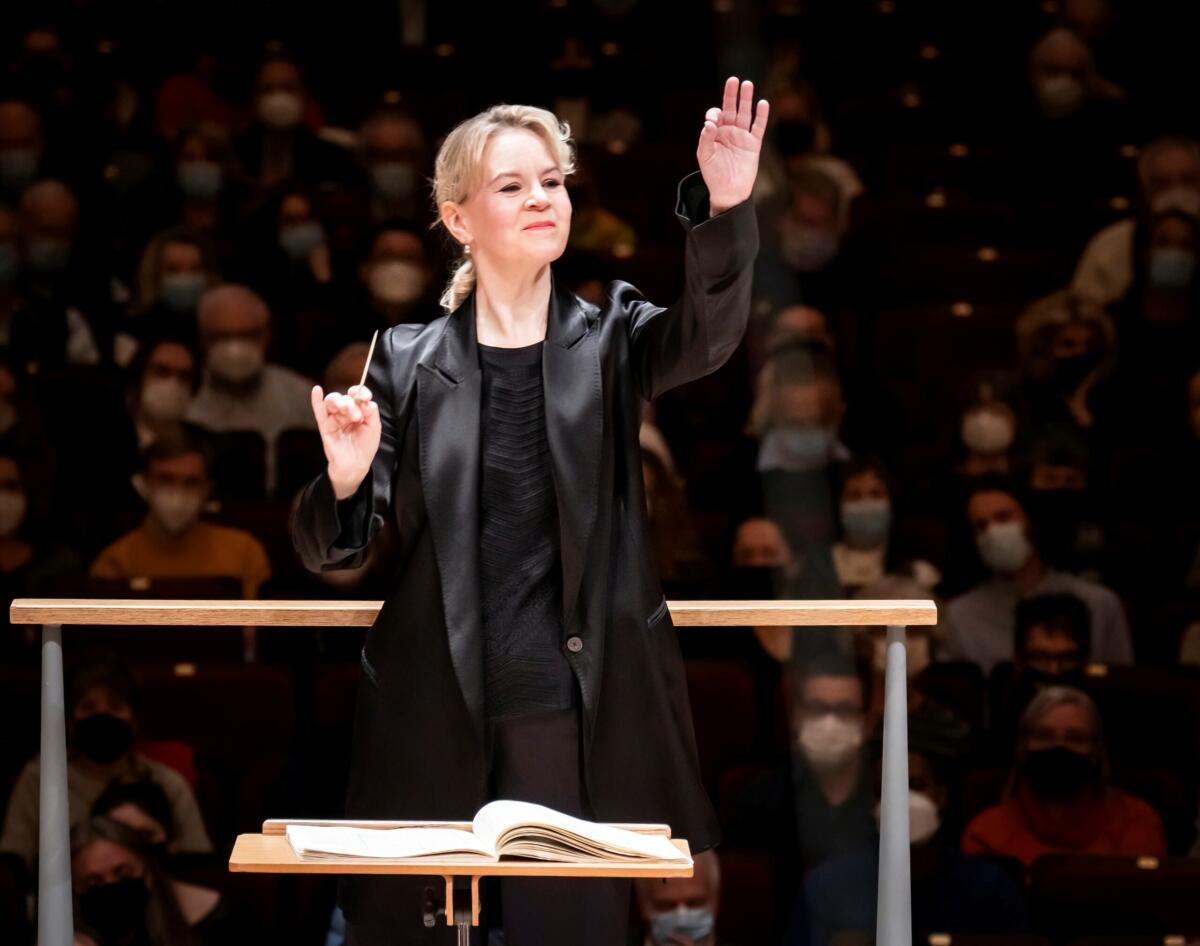
You have now been serving for about a year as Professor of Orchestral Conducting at the Sibelius Academy of the University of the Arts Helsinki. What has surprised you most during your first year?
The surprises have been positive! I’ve been impressed by our students’ thirst for knowledge, enthusiasm, and sheer drive to work. Compared with the orchestral world and its institutions, the Sibelius Academy is a highly dynamic environment. There is a distinct university energy here—a youthful intensity and eagerness to create—which I find absolutely fantastic. I’ve truly enjoyed being here.
My expectations were already high because I consider teaching such a wonderful profession. At the same time, it is an enormous responsibility when you think about how significant a stage of life higher education is, and how much new information and experience students encounter all at once.
How does teaching differ from conducting an orchestra?
The most interesting aspect of teaching is providing students with support and tools that allow them to become more fully themselves. It is not about how I personally want to interpret a piece, but about helping them discover their own voice and physical language of expression.
Teaching involves engaging deeply with a person’s individuality. A teacher must be able to put themselves in the student’s position in order to genuinely understand the processes the student is going through. Students are different from one another, and a teacher must develop a unique way of meeting each of them.
The teaching process is also far more long-term than orchestral work, where a conductor’s work is highly production-oriented. A project may last three days or five weeks, during which you travel from point A to point B and then move on.
In this profession, there are no ready-made solutions. Conducting is such a complex craft that it cannot function using someone else’s tools. Every conductor must find their own. That is precisely why teaching this profession is so fascinating.
How does individuality manifest itself in conducting a symphony orchestra, if at all?
A symphony orchestra is a team, and orchestral work naturally involves certain hierarchies. Communication is often unavoidably one-directional in verbal terms: the conductor speaks, and the musicians listen.
That does not mean, however, that personal connection and communication cannot emerge while the music is being played. There is a great deal of communication through eye contact and nonverbal interaction. Musicians suggest their own interpretations and solutions to the conductor through their playing. Communication can reach surprisingly deep levels in a very short time.
What is essential in conducting education?
I would say that one of a conductor’s most important qualities is the ability to see the forest for the trees. Since the conductor carries overall responsibility, they must also have a comprehensive vision—a clear artistic concept. Beyond that, they need the tools to realize that vision.
I want to help students recognize hierarchies between different elements. What requires attention? When should you focus on what? Conductors need the ability to react and process information quickly.
Finnish conductor training is known for producing conductors with strong and clear baton technique—that is, a clear gestural language. Technique is, in fact, largely a matter of having a broad vocabulary: the ability to express things in many different ways.
And at the center of everything is the music itself. Conductors may be visible and well-known figures, but we too are serving a greater purpose. We explore works together with the orchestra, and interpretations emerge from the choices we make in relation to the score.
A conductor must understand an entire structure that is being built on countless levels simultaneously. That is genuinely exciting.
How can you teach artistic vision?
My starting point is that anyone who wants to conduct an orchestra must already possess a vision. You can encourage it and draw it out, but it has to be there. The conductor’s task is to communicate that vision to the audience together with the orchestra.
People sometimes say that a great composition plays itself, but that is not true. Performance is about emphasis and choices. I often compare a musician’s work to that of an actor: the same text can be read in many different ways. An actor’s physical presence, voice, age, emphasis, pauses—all influence the impression and experience created.
With young conductors, interpretations are still developing, and they can be discussed: where should one be particularly attentive, and what follows from each choice? Together we explore cause-and-effect relationships.
How has the culture of the orchestral world changed?
Traditionally, it has been highly hierarchical, even authoritarian. But as society has changed, orchestral culture has changed as well. Today, orchestras expect a more collegial style of communication from their conductors, while still expecting a clear vision.
Conducting is sometimes compared to corporate leadership, where there is one leader and visionary guiding the organization toward success. But that is only partly true. Ultimately, it is always about collaboration.
The culture has also changed in that orchestras are expected to be far more versatile. Orchestras are often seen as highly conservative institutions, but today they must be capable of performing a wide variety of works and be open to new ideas.
Culture and working life are constantly changing. What kinds of professional skills will students need in the future?
I am looking forward to observing this closely in August, when I conduct the Sibelius Academy Symphony Orchestra in concert for the first time.
I think professional skills depend largely on the kinds of teachers students have had. Everyone in an orchestra is fundamentally an individual performer, a master of their own instrument. In the context of orchestral playing, professional skills involve not only teamwork but also situational awareness. How do you keep your antennas tuned to your surroundings while playing? You must listen to others and adapt, sometimes blending into the group and sometimes shining as an individual.
Another dimension concerns personal work ethic: whether you arrive thoroughly prepared. Although the orchestral world has changed, the core of the work remains the same. Everyone must develop their own skills through practice, and mastery grows through experience.
When I think back to my own youth as a cello student, there were things I only learned once I began playing professionally in orchestras. Instrument teachers focused on certain aspects, but orchestral work requires a special kind of precision simply because it involves such a large group of people who must function together seamlessly.
There is a great deal of uncertainty in the world. How can young people be encouraged to believe in their future as artists?
I am a maximal optimist. Art is meaningful and more important than ever.
We are moving strongly toward a technocratic era, and when people talk about artificial intelligence, there is often a fear that it will swallow us whole. It won’t. Absolutely not. Technology cannot replace human interaction.
We have nothing to fear. We have so much to offer.
At the same time, we must take ownership of the full spectrum of our humanity and become bolder in our expression—not for the sake of novelty, and not simply because something is beautiful, but as a gesture from one human being to another. That requires courage, taking up space, and refusing to apologize for the existence of art.
We can be a source of light and empowerment.
Concerts are experiences that cannot be obtained from television, the internet, or a store. They are energy—human energy exchanged between people. The experience is different for every individual, yet it is shared. There will always be a need and a place for such encounters. Research has even shown that the effects of artistic experiences can be observed at the cellular level.
To bring this back to teaching: if a young musician can shift their focus away from career alone and see their work as part of a larger mission, I believe there is a place for everyone.
What was it like to experience the success of the opera Innocence in New York?
My journey with Innocence actually began years ago when the work premiered in 2021. It was already a major success then. Many people have said along the way that Innocence restored their faith in opera as an art form. In New York, the scale of its significance became tangible.
The work fearlessly addresses a highly relevant contemporary topic in a crystallized and powerful way. The text by Sofi Oksanen is absolutely extraordinary. The story, with all its layers, the wisdom conveyed through the text, and the music of Kaija Saariaho—the opera achieves a magnificent synthesis in which everything falls into place.
Sitting in the orchestra pit and hearing Finnish sung at Metropolitan Opera House is difficult to describe. Many of the singers were international artists performing roles in Finnish. I always try to learn the meanings of words when working in a foreign language, and in this case I was able to explain the meanings and nuances of the Finnish text to our singers. That felt deeply meaningful. I genuinely love this text.
The opera also contains a wonderful folk-music dimension. Its expression is simultaneously Finnish and universal. In a sense, all folk music comes from the same source, and there is something deeply universal in the role and vocal expression of Markéta that resonates profoundly.
You are a role model for many people. Whom do you admire?
I admire many kinds of people. In particular, I admire those who work under difficult circumstances, such as the people of Doctors Without Borders. Sometimes I even wonder whether I have the right to do what I do when there are so many other ways I could be useful. I admire people who dedicate their lives to helping others and who work selflessly for the benefit of humanity.
I appreciate everyone who keeps this world running: parents raising children, and people who perform ordinary but meaningful acts every day.
I also admire extraordinary achievements—whether it is a pianist performing Ligeti’s sonatas with exceptional mastery or an elite athlete surpassing their limits. There is the same sense of purpose and determination in both. Yet all of this is possible only because people are human; our shared humanity is the most important foundation.
I believe art is essential. Innocence is a good example: it provides reflection, deeper understanding, and a chance to step outside everyday life. People need beauty, and aesthetic experiences are important in daily life.
I am aware that I am privileged to be able to do this work. That is why teaching is especially dear to me. I can pass on what I myself have received. I have had many excellent teachers, and I want to be part of that same continuum, carrying their knowledge forward.
All of us are trying to improve the world together—millimeter by millimeter, or one concert at a time. The emotions we experience through art remain with us long after material things disappear. Shared experiences are stored in the soul’s bank. The experience of music is powerful: it is collective and yet completely private at the same time, and it does not need to be put into words. It simply is true.