


Different approaches to dramaturgy and performance studies
Yamélie Spautz and Güde Nissen study on a Comparative Dramaturgy and Performance Research (CDPR) master’s programme. They will graduate from two universities, Uniarts Helsinki and their home universities in France and Germany.
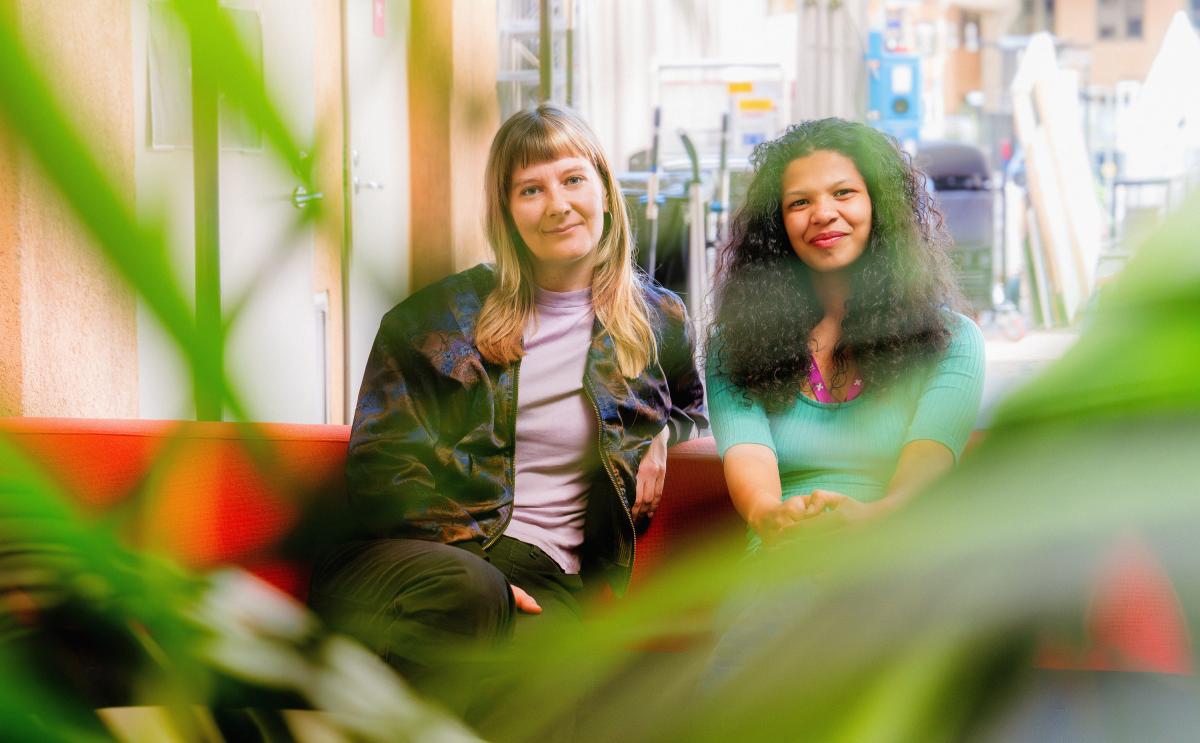
In the Comparative Dramaturgy and Performance Research (CDPR) master’s programme, students study at two of the following universities: Goethe University in Frankfurt, Oslo National Academy of the Arts, ULB University in Brussels (Université Libre de Bruxelles), University Paris Nanterre and Uniarts Helsinki. One of the universities they choose is their home university, but they graduate from both universities. The programme is the first double-degree programme at Uniarts Helsinki.
Yamélie Spautz received her bachelor’s degree and first master’s degree at the University of Sorbonne Nouvelle in Paris, where she studied theatre. In September 2025, she began her studies on the CDPR master’s programme at University Paris Nanterre and in January 2026 she moved to Uniarts Helsinki.
“When I heard about the CDPR programme, I immediately got interested in the cooperation between the five universities in different countries. I saw how this programme would open my world. I really wanted to live in a Nordic country. I chose Finland, because I didn’t know much about the country or its theatre culture. In France, we learn more about Norway and Ibsen than about Finnish drama,” Spautz says.
The students study the first semester at their home university, the second and third abroad and the fourth semester again at home. ULB University and University Paris Nanterre have French as the main language of education. At the other universities, CDPR studies are offered in English, German, and Norwegian.
“I was very surprised when I learned how young the Finnish theatre history is compared to the long history of French theatre. It’s interesting how the birth of Finnish theatre is also intertwined with the birth of Finnish nationality and independence from Russia and Sweden,” Spautz says.
Uniarts Helsinki offers very practical performance studies and studies in artistic research
While the four ‘home students’ are studying at the partner universities, the four ‘international students’ are participating in the CDPR studies at Uniarts Helsinki in spring and autumn 2026. In addition to Yamélie Spautz, there are two German students and one Finnish student. One of them is Güde Nissen, whose bachelor studies included languages, literature and pedagogy. She began her studies at Goethe University in Frankfurt and came to Helsinki in January 2026.
“During my bachelor’s degree, I did an internship at a theatre in Berlin and got hooked on theatre. I ended up working six years in different theatres first as an assistant and then as a freelance director. In 2025, I chose the CDPR programme because I am passionate about all performing arts. I like to move between different medias and create experiences outside the traditional theatre space. CDPR emphasises openness for various forms of performance,” Nissen says.
Uniarts Helsinki is the first art university she has studied in.
“Goethe University is more about critical thinking and theoretical background, not just art. I got interested in Uniarts Helsinki because they have a long history of artistic research and I would like to continue my studies even after my master’s degree,” Nissen says.
Both Nissen and Spautz consider the studies at Uniarts Helsinki to be very practical.
“It’s interesting to get these different approaches to dramaturgy and performance. Goethe University helps me to reflect on what we are doing, and Uniarts Helsinki helps to put theory in practice,” Nissen says.
Spautz agrees that her studies at University Paris Nanterre are more theoretical. She also finds that in Finland the relationships between teachers and students are less formal.
“We do practical work on stage also in France, but we do it through our roles as dramaturgs, directors or actors. Theory and practise are more separated. At Uniarts Helsinki, we consider more holistically what we can do with our senses and reflections about the topic at hand. At Uniarts Helsinki, we use creative practice for thinking. It’s great to get to know dramaturgy in many ways,” Spautz says.
Nissen also points out some features of Finnish theatre practice.
“In Finland, there is a strong engagement with the surrounding world, like society and the environment. It’s not about creating a perfect theatre piece, but embracing the explorative in the performance,” Nissen says.
Experiences on ice and on stage
Nissen and Spautz have enjoyed their time in Helsinki and within the student community at Uniarts Helsinki. Nissen feels that the teachers support her own creativity.
“We had a very cold winter. In January and February, we spent a lot of time outdoors doing our Exploring Performance modules, and it was wonderful! We even went walking on ice on the frozen sea. I have really enjoyed the fact that we haven’t been confined inside four walls all the time. I find that it has been easy to get to know people here and it has been interesting to collaborate with other art students like singers, actors, choreographers and dancers,” Nissen says.
The university and the group of CDRP students are comparatively small.
“When the study groups are small, everyone must be constantly active. You can’t take a back seat, but then again, you learn a lot. By communicating with the other CDPR students, we get perspectives from different universities and we learn from each other,” Nissen says.
Spautz feels that the students inspire each other.
“We find our own technique by working together. The biggest challenge has been to get to know all the new people, the city of Helsinki, and the schedule at the university. We also use many languages in our group and translate things for each other. But we are lucky to have such a great group of students to work with,” Spautz says.
Dreams about future career possibilities
These master’s students already have quite concrete dreams about the future.
“I would like to work as a dramaturg, and I would especially love to do musical productions. This spring, at the Helsinki City Theatre, I saw the children’s musical Veljeni Leijonamieli and that was a great production. At the Theatre Academy, I saw a musical called From me to you: How shall we eat v.1.0. The play was very experimental and ecological, which is typical for the productions at Uniarts Helsinki,” Spautz says.
Nissen is worried that the possibilities for artists are becoming scarcer in today’s world. She would like to continue to make art and do artistic research.
“I want to build a wide, versatile network. I hope I can get some artistic freedom to do the kind of performance arts I believe in as a dramaturg and director with many kinds of people. I find that CDPR studies have encouraged me to find my own way. I want to make art that impacts the world,” Nissen says.
The CDPR programme takes new students every other year. The next round of admissions opens in January 2027 for the academic years 2027-2029. For more information, please visit the programme’s page.
Text: Päivi Brink
Photo: Petri Summanen