


75 years of higher education in church music
The Sibelius Academy’s Church Music Department is celebrating its 75th anniversary together with Kimu ry, the church music students’ association, which turns 30 this year.
We spoke to Timo Kiiskinen, Head of Church Music and Organ, and church music student Kikko Siltanen about the many things church music can be.
“Church music is not just music in church, but music about being human. There is room for every emotion,” Siltanen says, emphasising that people are at the heart of the field.
“Church music reaches an enormous number of people every week, often at moments when they are facing something truly fundamental: birth, love, loss, death or a new stage of life.”
A long tradition with many possibilities
Kiiskinen reminds us that church music has deep roots in the history of Western music. This centuries-old tradition still offers a wealth of material to explore, but today’s education also looks firmly towards the future.
Church music students do not train to master just one instrument. Their studies combine organ playing, singing, conducting, composition and arranging, for example. This broad range of skills prepares them to work in very different musical settings.
Kiiskinen believes that this versatility will be one of the programme’s strengths in the future. Alongside parishes, church music expertise is needed in work with children and young people, community music activities and music in care settings, for example.

Siltanen describes today’s church music as, above all, diverse music that touches people. “It is not just one particular style or sound. It can include traditional hymns and organ music, but also choral music, gospel, pop and entirely new compositions.”
A long tradition is compatible with renewal. Church music must also be able to speak to people today.
“It does not have to sound a certain way to be church music. Good church music makes you pause, offers comfort, prompts thoughts about spirituality too, and brings people together.”
You hear church music even if you do not go to church
The influence of church music extends far beyond church walls. Siltanen points to films, series and games that draw on instruments, melodies and soundscapes familiar from church music. Gregorian melodies and the aesthetics of choral music can be heard in many forms of contemporary music.
“Church music is not just a genre you have to seek out and listen to separately, but part of our shared musical culture.”
Kiiskinen, meanwhile, notes that churches form an exceptionally extensive network of concert venues in Finland. In a small town, the church may be the main concert hall. Parishes also organise musical activities for people of all ages, from early childhood music groups to communal singing and concerts.
Church music also often touches people at special moments in their lives. According to Siltanen, church music is ultimately not just about making music, but above all about being with people and connecting with them.
“Music always happens in a particular context and with someone. It may involve joy, grief, weddings, funerals or an ordinary Sunday. Sometimes that connection happens just as much over coffee after a service as through music. A musician needs to be able to listen to people and talk with them. You cannot learn that from sheet music or in a practice room alone.”
Virtuosity or human connection?
Kiiskinen also reflects on the relationship between music and human connection. Musicianship at a high level requires a great deal of technical skill and practice. Yet, he says, the meaning of music cannot be reduced to virtuosity.
“Is it more important that we get to hear impressive technical or musical virtuosity, or is the occasion a social one, where music really reaches people and becomes a way of connecting with them?”
The answer is not either–or. Professional skills must be of a high standard, but a musician must also be able to communicate something from one person to another.
In church music, this idea is especially tangible. Musicians work not only on the concert stage, but within communities and in situations where music can have a deeply personal meaning.
The organ is an entire orchestra and almost a building
One of the most recognisable symbols of church music is an instrument whose possibilities extend well beyond the stereotypes associated with it.
“You can do an incredible amount with the organ,” Siltanen says.
Alongside classical and sacred music, it can be used to play pop and metal, for example, and to accompany singers and other instruments. Kiiskinen compares the possibilities of a large organ to those of an entire orchestra: its different pipes and stops produce an enormous range of tone colours.
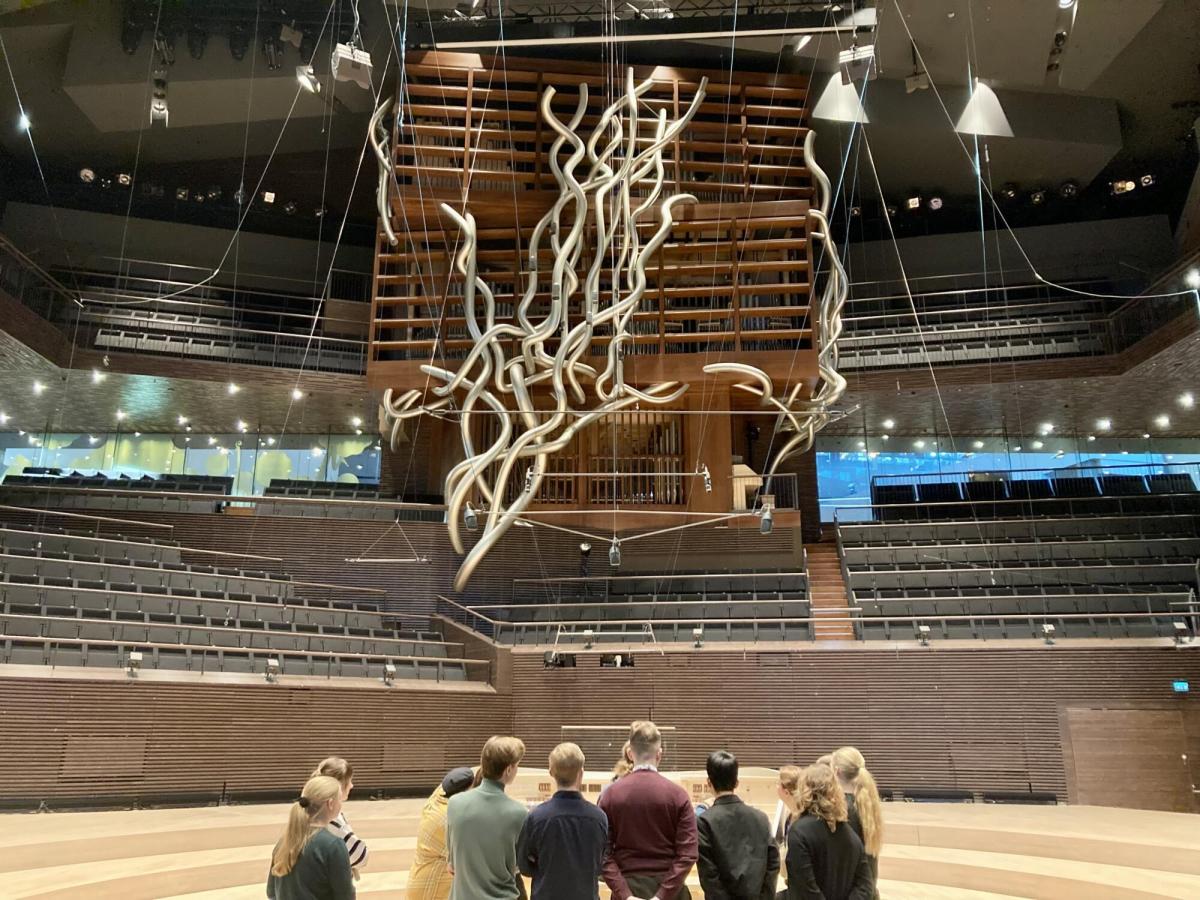
The new organ at the Helsinki Music Centre makes this idea particularly vivid. When the orchestra plays alongside it, the organ is one part of the whole. When the orchestra falls silent, the organist can seem to become an orchestra in their own right.
Siltanen points out that the organ is also physically unlike any other instrument.
“It is not just an instrument, but a ‘building’ of its own. When tuning a large organ, you get to climb quite high.”
And if the sermon is long, Siltanen says, you can also move quietly around the organ loft and keep yourself limber.
Coffee at the bend and different strengths
The future of this 75-year-old programme is being shaped by today’s students. Both Kiiskinen and Siltanen highlight the community of church music students.
“I think there is a really good buzz here at the moment,” Kiiskinen says. For him, working with students is one of the best parts of being a programme director.
In the students’ everyday lives, this sense of community has a gathering place of its own: “Kimu’s bend”, a bend in the corridor by the organ classrooms where students catch up and share “coffee at the bend”.
According to Siltanen, different strengths bring students together rather than setting them against one another. One student may specialise in singing, another in the organ or something entirely different. They learn from each other’s skills, support one another at performances and easily find company for meals.
The programme also gives students room to develop their own musical identity. Siltanen has had the opportunity to work extensively on art songs with singers and to pursue the highest-level piano performance examination, known as the A-level examination.
“The best thing is the combination: you can focus on your own area of expertise and become really good at it, but you do not have to do everything alone.”
Perhaps this also captures something essential about 75 years of church music education. The tradition is long, but its purpose is not to remain unchanged. Generations, musical styles and society evolve, while music and people remain at the heart of the work, along with the question of how to bring them together.