


Praxis student: I am excited about the programme’s conversational approach
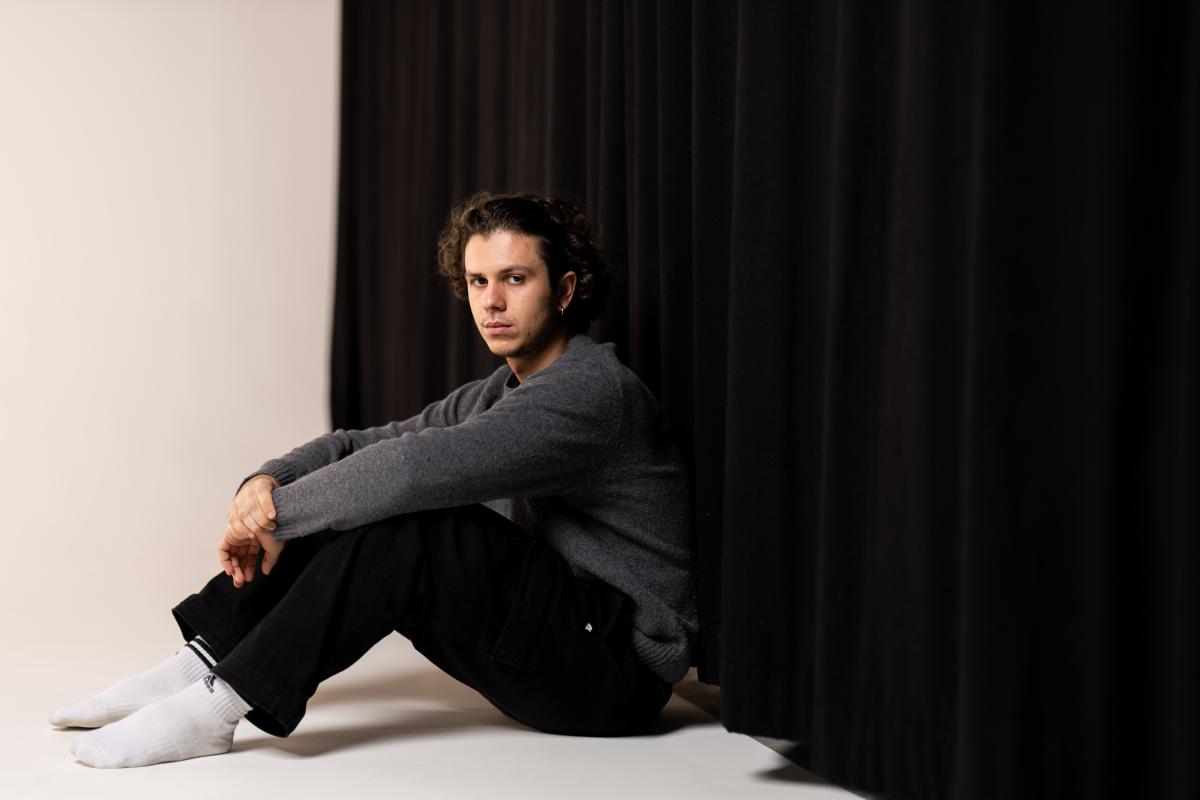
Italian Guglielmo Benassi is a first-year student in the Praxis – Master’s Programme in Curating and Writing in Contemporary Art at Uniarts Helsinki. The first month of his studies has already offered him some practical curatorial training.
Where are you from and where did you study before coming to Uniarts Helsinki’s Academy of Fine Arts?
I am from Milan in Italy. For my BA degree, I studied photography at the European Institute of Design in Milan. I have worked mainly with fashion photography. Before I applied to the Praxis programme, I worked as an assistant at the exhibition project Camera Doppia. It was an amazing experience, and I realised I wanted to learn more about curating exhibitions.
Why did you want to study in the Praxis programme and why did you choose Uniarts Helsinki?
I knew I wanted to study curating, and I investigated options around Europe. I didn’t know Uniarts Helsinki or its Academy of Fine Arts at all, but I heard about it from a friend, who studies at Aalto University in Helsinki. I read about the Praxis master’s programme online, and I was immediately drawn to the combination of practice and theory.
I visited my friend in Helsinki in July this year, and I liked Helsinki from the first day. I felt a connection to this town, and I find it very open and interesting. The Finns are not as withdrawn as Italians think.
What do you remember about your application process?
I remember that I was asked what kind of resources I would bring with me to Uniarts Helsinki and Finland. I thought that was a good question. All the students who were chosen for the programme have very different backgrounds. We learn a lot from each other.
The admission process started in January, and it was very clear and easy to understand. I understood what was expected of me at every stage of it. Application processes in Italian universities can be chaotic, so I appreciated the clarity. I did the application interview on Teams, and I didn’t have to travel to Finland. That saved me time and money.
When did you start your studies? What have the studies been like?
I began my studies in the Praxis programme only a month ago, on the first of September 2026. We have experienced so much already! There is one other foreign student in my class and the others are Finnish. We are a very heterogeneous group, but we enjoy each other’s company. We are encouraged to work together rather than to compete with each other. I think that is a very healthy way of learning.
We have been working with some actual art projects, and they have been very interesting. We are curating an exhibition with works from the Päivi and Paavo Lipponen Art Collection, which is part of Museum of Contemporary Art Kiasma’s collections. The exhibition will take place at Uniarts Helsinki’s gallery called Kuva/Tila. Uniarts Helsinki has immediately put us in dialogue with the art scene in Helsinki, and we are already working together with artists and institutions.
The theoretical and practical classes work very well side by side, and we get to apply theory to practice right away. I enjoy the teaching methods at Uniarts Helsinki, because there is a lot of dialogue and conversation. That was not the case during my previous studies, where teachers spoke and students listened.
What have you enjoyed the most in your studies?
The best experience during this first month has been a three-day symposium where we met art professionals from Finland and abroad. During the symposium, I gained a much better understanding of the art institutions in Finland than before. I also learned more about Uniarts Helsinki, which is very well connected to the art scene both in Finland and internationally.
Has anything been challenging so far?
In this master’s programme, we write a lot, and that is fairly new to me. I am curious to learn how to become a better writer, and it feels somehow natural for me.
I would like to learn more Finnish, since now I only know a couple of words. Everyone speaks English though, so that has not been a problem.
The master’s programme takes two years to finish. Between the two years of study, during the summer months, we have a paid internship period. I would like to do my internship in Finland, maybe in a gallery or a museum. In the second year, we concentrate mainly on our thesis.
How do you find studying in Helsinki and in Finland, the happiest country in the world? Is it different from your own country?
I feel a strong connection to the city of Helsinki, and I already feel like I belong here. Finns have a different approach to life than Italians, but they are not as cold as I thought. The stereotypes about the Nordic people are not true! I would like to stay here for some years.
The art scene is different from Italy, where we have a long art tradition and a strong contemporary art scene as well. What I have particularly noticed in Finland is the way institutions cooperate with each other and the open-minded approach to collaboration. It seems to me that Helsinki wants to take on a more prominent position at the centre of the international art scene than before.
How do you see your future after you graduate?
I am interested in new technologies and AI, and I am curious about how they will change our perception of art and life in future. Right now, I am interested in writing my thesis about new technologies and art, but that may change.
I would like to work in Finland as a curator, writer and teacher. During my studies, I want to learn more about pedagogy and research methods.
What kind of impact do you want your art to have on the future?
My work experience at Camera Doppia showed me how art can influence the whole community. I would like my work to be useful to society. My work as a photographer used to be commercial, but now I am more interested in cultural and educational work. Curating can also be good for society, because it can make people think.
Text: Päivi Brink