


Angela Melitopoulos: Cine(so)matrixial film installations
Angela Melitopoulos is an artist based in Berlin and Mitilini/Greece who has made experimental video-essays, installations, documentaries and sound pieces since 1985. In this open lecture, Melitopoulos will present a cine-somatic excursus with excerpts of her works.
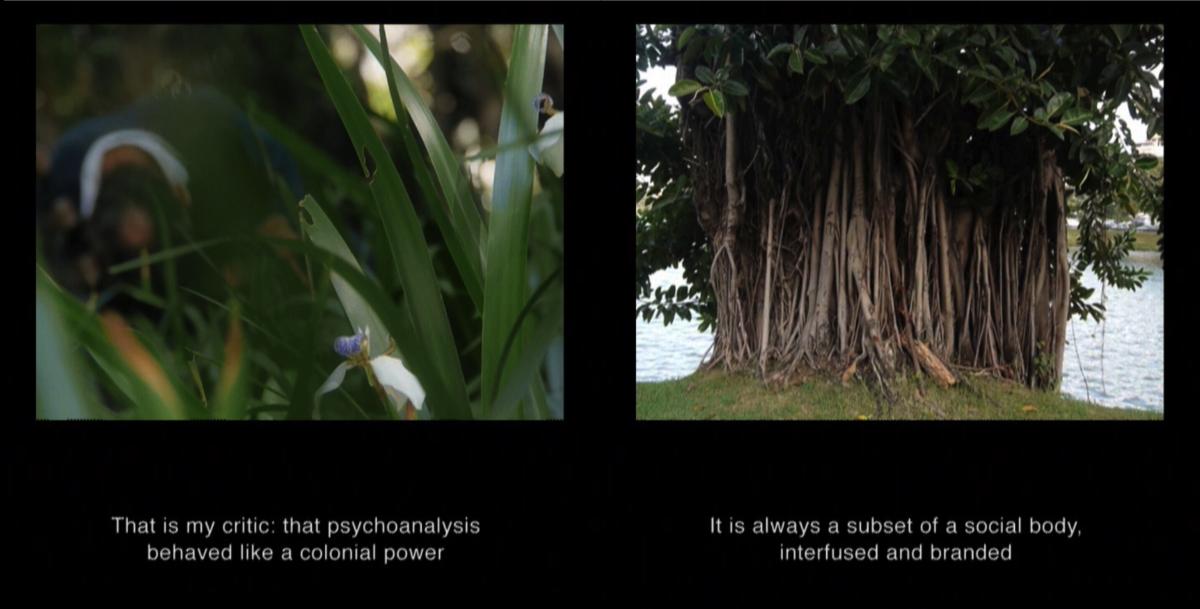
“The lecture will re-iterate some of my video installations and video essays that transversally pass through the question of what anti-colonial cinematic tools could be and that shed light on what I call cine(so)matrixial works, connecting conditions of migration, revolutions in the anti-psychiatric movements and eco-feminist ideas of ecology.”
Angela Melitopoulos will present a cine-somatic excursus with excerpts of her installation works presented in 2022 in her solo exhibition Cine(so)matrix at the Museo Nacional Centro de Arte Reina in Madrid. The relation between movement (cine) body (soma) and matrixiality (matrix) leans on the relation between the cine-eye, body movements and a milieu that corrodes our understanding of liminality between inside and outside.
Following Felix Guattaris’ interest in animist cosmologies and his fundamental critique of modernist concepts, Melitopoulos developed in her works Assemblages, Deconnage and The Life of Particles (2009–12 with Maurizio Lazzarato) the idea of a “machinic animism”. This cinematic image production comprehends non-linear connectivities and an ecological participatory thinking through editing, weaving and story-telling in time-based image cultures.
Rethinking Guattari’s idea of ‘the Object, the Other as a potential bearer of dimensions of partial subjectivity, if need be through neurotic phenomena, religious rituals, or aesthetic phenomena’ , is expanded in her newer research projects as a matrixial and ecological practice. Melitopoulos migratory perspectives in that the question of participating in a “world-making” in the production of contemporary subjectivities is highlighted, resonates back with the revolutionary beginnings of geo-psychiatrie and it’s ecological becomings.
In cinematic movements the body (soma) appears as an embodied perspective in perception, a ”cine-eye” as the soviet filmmakers of the Dziga Vertov Group named it, or, as later in the experimental films of the french ”cinema vertité” expressed it as an ”image-time-matter” that excess systems of representation of an existing world but that create the visions and the memory of a becoming world. Or, as Viveiros de Castro, a leading anthropologist from Brazil stated, that function as a system of vision that maps the body eyes of all living entities in a space and explains indigenous cosmologies – for example in the ”Arawete” societies in Brazil. These animist societies, as Viveiros states, do not want to be organized by a (colonial) ”state” and they ”are essentially societies against the state”.
About Melitopoulos

Angela Melitopoulos is based in Berlin and Mitilini/Greece and has been making video essays, multi-screen installations, documentaries and music pieces since 1985. Melitopoulos studied at the Nam June Paik Academy of Art in Düsseldorf, at the Academy of Media Arts in Cologne with Valie Export. She has a Phd in Visual Cultures (thesis titled Machinic Animism and the revolutionairy practice of geo-psychiatry, Goldsmith’s University of London, Center for Research Architecture, 2015).
Her works consist of multi-screen installations, video-essays; net-based, collective montage projects, activist projects, performative archive presentations in cinema and installations in public space and Industries of Denial (2022). She regularly collaborates with artists and scholars in Europe, Turkey, Japan, Brazil, Korea, USA. A retrospective of her work at the Museo Nacional Centro de Arte Reina Sofia took place in June 2023.
Angela Melitopoulos works on cine(so)matic cartographies in which moving bodies and site traversals create mnemonic milieus. Her interest in the theoretical qualities of time-based media include a constant exploration of duration, memory, geography and subjectivity in relation to non-linear narratives and their technical procedures. Her collaboration with sociologist Maurizio Lazzarato in the 1990s led to the book publication Videophilosophy (Edition bbooks Berlin, 1997), which further spun Henri Bergson’s theses (Matière et Mémoire) as technical, aesthetic and social memory with media art. Melitopoulos is interested in the mnemonic capacities of our perception of time as a digital trace in archives or in the geology of the landscape. The narratives of subterranean, collective memory transmissions stand for a post-colonial alliance. Against a homogenisation of subjectivity, she understands the auto-poetic logic in media art as an order of thought against the mainstream. She tells of deviant, collective forms of memory of resistant subjectivities and of revisions of history, of imperialist violence, fascism and the experience of migrations in the 20th century.
Visiting professors lecture series
Uniarts Helsinki’s Academy of Fine Arts regularly invites distinguished international artists and art experts to teach for a fixed period. The visit also includes a public lecture that is open to all. uniarts.fi/visiting-professors.
“The lecture will re-iterate some of my video installations and video essays that transversally pass through the question of what anti-colonial cinematic tools could be and that shed light on what I call cine(so)matrixial works, connecting conditions of migration, revolutions in the anti-psychiatric movements and eco-feminist ideas of ecology.”
Angela Melitopoulos will present a cine-somatic excursus with excerpts of her installation works presented in 2022 in her solo exhibition Cine(so)matrix at the Museo Nacional Centro de Arte Reina in Madrid. The relation between movement (cine) body (soma) and matrixiality (matrix) leans on the relation between the cine-eye, body movements and a milieu that corrodes our understanding of liminality between inside and outside.
Following Felix Guattaris’ interest in animist cosmologies and his fundamental critique of modernist concepts, Melitopoulos developed in her works Assemblages, Deconnage and The Life of Particles (2009–12 with Maurizio Lazzarato) the idea of a “machinic animism”. This cinematic image production comprehends non-linear connectivities and an ecological participatory thinking through editing, weaving and story-telling in time-based image cultures.
Rethinking Guattari’s idea of ‘the Object, the Other as a potential bearer of dimensions of partial subjectivity, if need be through neurotic phenomena, religious rituals, or aesthetic phenomena’ , is expanded in her newer research projects as a matrixial and ecological practice. Melitopoulos migratory perspectives in that the question of participating in a “world-making” in the production of contemporary subjectivities is highlighted, resonates back with the revolutionary beginnings of geo-psychiatrie and it’s ecological becomings.
In cinematic movements the body (soma) appears as an embodied perspective in perception, a ”cine-eye” as the soviet filmmakers of the Dziga Vertov Group named it, or, as later in the experimental films of the french ”cinema vertité” expressed it as an ”image-time-matter” that excess systems of representation of an existing world but that create the visions and the memory of a becoming world. Or, as Viveiros de Castro, a leading anthropologist from Brazil stated, that function as a system of vision that maps the body eyes of all living entities in a space and explains indigenous cosmologies – for example in the ”Arawete” societies in Brazil. These animist societies, as Viveiros states, do not want to be organized by a (colonial) ”state” and they ”are essentially societies against the state”.
About Melitopoulos
Angela Melitopoulos is based in Berlin and Mitilini/Greece and has been making video essays, multi-screen installations, documentaries and music pieces since 1985. Melitopoulos studied at the Nam June Paik Academy of Art in Düsseldorf, at the Academy of Media Arts in Cologne with Valie Export. She has a Phd in Visual Cultures (thesis titled Machinic Animism and the revolutionairy practice of geo-psychiatry, Goldsmith’s University of London, Center for Research Architecture, 2015).
Her works consist of multi-screen installations, video-essays; net-based, collective montage projects, activist projects, performative archive presentations in cinema and installations in public space and Industries of Denial (2022). She regularly collaborates with artists and scholars in Europe, Turkey, Japan, Brazil, Korea, USA. A retrospective of her work at the Museo Nacional Centro de Arte Reina Sofia took place in June 2023.
Angela Melitopoulos works on cine(so)matic cartographies in which moving bodies and site traversals create mnemonic milieus. Her interest in the theoretical qualities of time-based media include a constant exploration of duration, memory, geography and subjectivity in relation to non-linear narratives and their technical procedures. Her collaboration with sociologist Maurizio Lazzarato in the 1990s led to the book publication Videophilosophy (Edition bbooks Berlin, 1997), which further spun Henri Bergson’s theses (Matière et Mémoire) as technical, aesthetic and social memory with media art. Melitopoulos is interested in the mnemonic capacities of our perception of time as a digital trace in archives or in the geology of the landscape. The narratives of subterranean, collective memory transmissions stand for a post-colonial alliance. Against a homogenisation of subjectivity, she understands the auto-poetic logic in media art as an order of thought against the mainstream. She tells of deviant, collective forms of memory of resistant subjectivities and of revisions of history, of imperialist violence, fascism and the experience of migrations in the 20th century.
Visiting professors lecture series
Uniarts Helsinki’s Academy of Fine Arts regularly invites distinguished international artists and art experts to teach for a fixed period. The visit also includes a public lecture that is open to all. uniarts.fi/visiting-professors.