


Kaisa Rönkkö: ”Universities do not preserve the past for the sake of the past. They preserve what we want to hold on to – now and in the future”
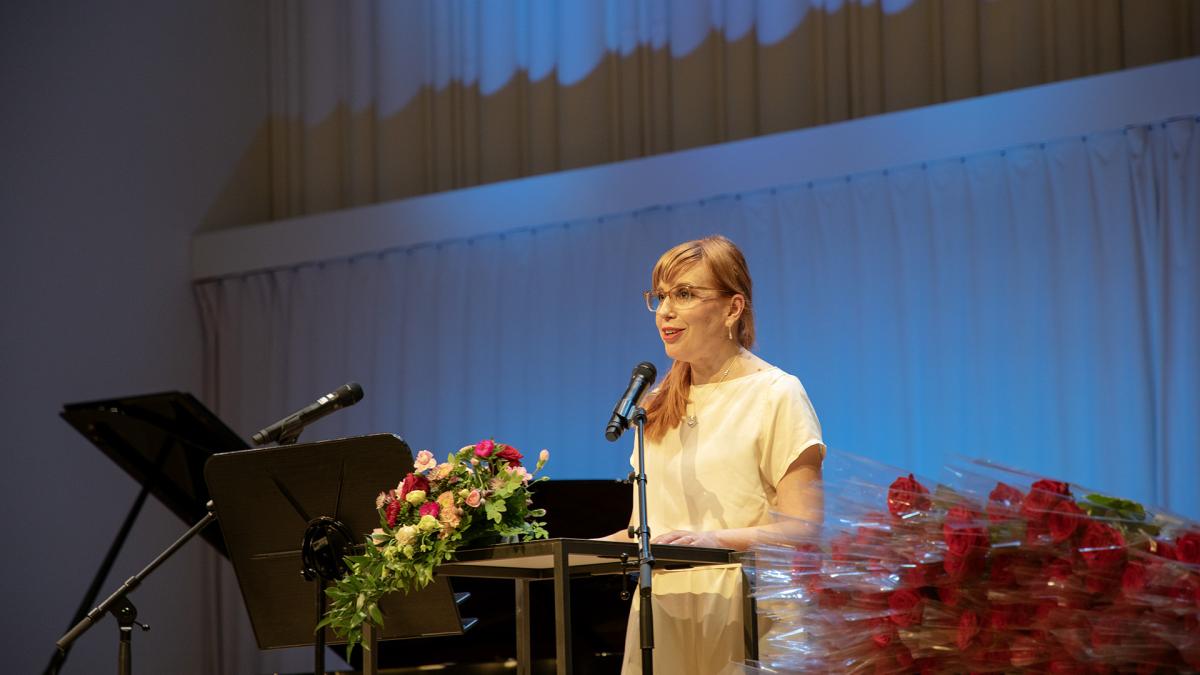
Speech by Kaisa Rönkkö, Dean of the Sibelius Academy, at the Graduation Ceremony on June 12, 2026.
Dear Graduates, Families, and Colleagues,
The purpose of a university is not simply to make sure that as many students as possible graduate within the target time frame. The purpose of a university is to pass on knowledge, skills, learning, and understanding from one generation to the next; to cultivate the ability to doubt and question, to see differently. To create and think things that have not been created or thought yet.
It is an extraordinary mission. A mission never meant to be finished. As students, you do not owe the university a degree completed on schedule, even if the headlines may suggest so. What you do owe our honorable academic tradition is this: that you receive something that belongs to all of us, nurture and develop it, contribute something of your own, and in time, pass it on.
Graduation is more than just receiving a degree. As you graduate, you join a global community that sustains our humanity. A community that has continued a conversation for more than two millennia. A conversation about what is true, what is good, what is beautiful, what is just, and what human dignity means. You are warmly welcomed into this community. But what are you to do with the knowledge, skills, and freedoms that have been entrusted to you?
***
The word “academy” derives from the place where Plato taught nearly two and a half millennia ago. That place, the Grove of Academe, was named after the mythical Greek hero Academus. It was a garden-like area filled with olive trees. There were walking paths, gymnasiums, and shrines. The academic tradition began with people walking together, conversing, debating, questioning, and nourishing both body and soul.
Above all, the academy was a community. A community that believed truth was worth seeking and that knowledge ultimately belongs to the common good.
You, too, inherit not only knowledge but a place within a community dedicated to pursuing understanding for the benefit of all. The legacy of the academy is not a collection of theories and answers. It is the capacity to ask questions.
Perhaps that is why universities have endured – not because the world has remained the same, but because it continues to change. Human beings have always needed knowledge, both old and new, and we need it now more than ever.
We need people who question, and we need questions.
Socrates lived in a time when Athenian democracy was faltering.
Plato witnessed his teacher Socrates being sentenced to death for daring to ask difficult questions.
Augustine studied and wrote as the Roman Empire was disintegrating.
In 1348, the plague swept across Europe. In 1517, the Reformation transformed an entire continent. In 1914, the world descended into global war. In 1939, an entire generation was forced to ask whether learning, freedom, and human dignity would survive. In 1962, humanity held its breath on the brink of nuclear war.
Today, we have our own uncertainties and transformations, our own questions and echoes.
Every generation has had to live with uncertainty.
Every generation has had to ask what is worth preserving.
And this is precisely where the significance and purpose of the university lie.
Universities do not preserve the past for the sake of the past.
They preserve what we want to hold on to – now and in the future.
Freedom of thought.
The pursuit of truth.
Learning and cultivation.
The freedom of art and science.
Human dignity.
Responsibility for one another.
These things are not preserved in university buildings or libraries.
They survive within us.
***
One of the paradoxes of graduation is that the more you learn, the more clearly you see how much remains to be learned. The more one understands painting, for example, the more clearly one sees its complexity. I hope you also see clearly that you are not alone.
Today, we celebrate your tremendous achievement. But do not worry if everything is not yet clear. It cannot be. Graduation is not meant to be the endpoint of a conversation, the moment when everything is settled.
Graduation is an invitation to join that conversation as a full member of our academic community.
***
What is the long chain you have the honor of joining today?
Socrates asks questions in the marketplace of Athens.
Plato founds the Academy.
Hildegard of Bingen composes, writes, and studies the world at a time when women were rarely given the opportunity to be heard.
Ibn Rushd defends reason in Córdoba.
Maimonides seeks connections between faith, reason, and ethics.
Dante rewrites the very image of the world.
Erasmus champions learning.
Galileo raises a telescope toward the heavens.
Mary Wollstonecraft demands education for all.
Frederick Douglass transforms literacy into an instrument of freedom.
Sibelius helps a nation find its own voice.
Edith Södergran writes for a world that does not yet exist.
Hannah Arendt asks what happens when people cease to think.
Arendt leaves us with a question that may be even more relevant today than in her own time: How do we preserve our capacity for deep thought in a world where information is more abundant than ever?
How do we preserve judgment in a world that rewards speed?
How do we nurture our ability to form our own opinions in an age that pressures us to choose sides before we have had time to understand?
How do we encourage ourselves to listen to one another in a time when retreating into agreement, or simply walking away, often feels safer than conversation?
How do we maintain our capacity to think independently when society, algorithms, and ideologies constantly tempt us with ready-made answers?
How do we trust one another enough to say when someone is wrong?
Dear graduates, there is a place for you, and there is a task for you, at the very heart of the university ideal.
Our future depends on people who ask: Is this true? Is this right?
Could this be done better? What kind of world are we building?
Art and science have a special role in this work.
***
Today, you do not take an oath, as doctors, officers, or clergy do upon graduation.
Yet I am fond of the idea of an oath, because an oath is not about status achieved but about responsibility.
The knowledge entrusted to a physician concerns human life.
The authority entrusted to an officer concerns security.
The word entrusted to a priest concerns meaning, hope, and truth.
All are united by the same question:
How will I use what has been entrusted to me?
Dear graduate, I would like to propose our own kind of oath.
An oath in which we promise to use the knowledge, skills, freedom, and imagination we have received according to the best of our understanding.
We promise to enjoy the freedom of art and science.
We promise to use them for the common good.
We promise that we may be conventional or experimental, innovators or preservers, traditionalists or revolutionaries, unprecedented, slow or fast, cautious or daring—each of these separately and all of them at once.
But above all, we promise to stand on the side of what is good. We promise, each in our own way, to contribute to the common good.
Today, you graduate as professionals in music and the arts, entering many different roles and responsibilities. You will work across various sectors of society and encounter diverse communities, demands, and opportunities.
They all share one thing: You work with meaning. You work with the things through which people form their understanding of themselves, of one another, and of the world.
That is why art belongs at the university and rightfully holds its place as a member of the academic community. At the heart of art are both skill and knowledge.
Art does not merely depict or explain the world – it enlarges it. It reveals possibilities we do not yet know how to see. It keeps open the possibility that the world could become more than it currently is.
The poet Edith Södergran wrote:
“I must not make myself smaller than I am.”
I do not hear this as a call to selfishness but to responsibility.
If we have been given a voice, we must use it.
If we have been given the gift of thought, we must think.
Becoming fully ourselves is not a gift only to ourselves, but to society as a whole.
To all of us.
Dear graduates,
Today you join a community that has traveled from an olive grove in antiquity to this very hall. A community that will continue long after us.
Take your place in it with pride.
Serve what is good—with courage, wisdom, and joy.
Use your knowledge, your skills, and your freedom responsibly.
We trust you.
Now it is your turn.
I am proud of you.