


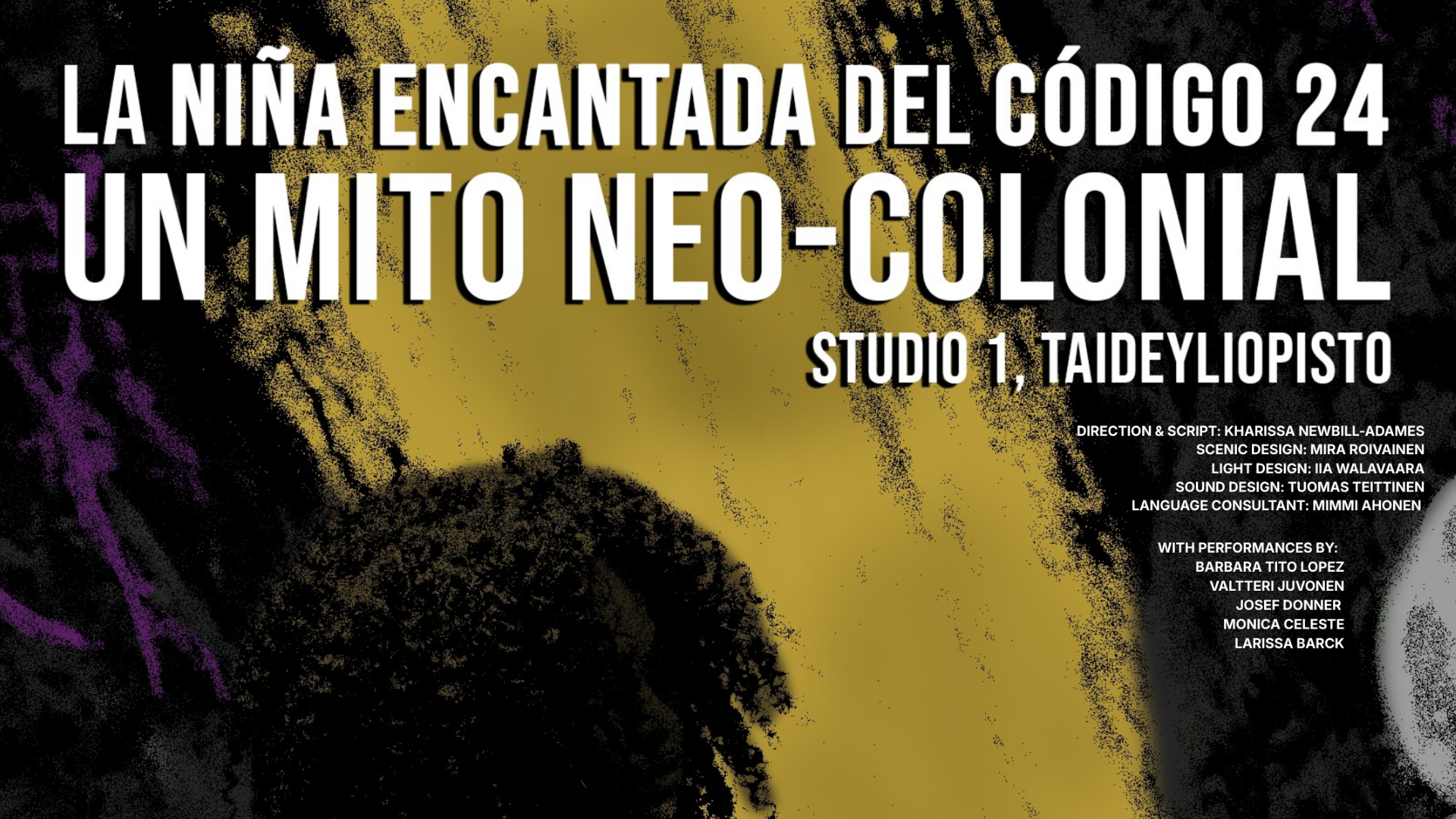
The Enchanted Girl of Code 24: a neo-colonial myth
La niña encantada del código 24: Un mito neo-colonial
Director’s word
The Enchanted Girl of Code 24 was born at the intersection of personal experience and ancestral memory, in an exploration of Latine history and inheritance. The play centers magical realism as its form: the meeting of the magical within the real, a way of approaching sensitive and trauma-based histories through a degree of separation that allows us to look without turning away.
This tradition spans across Latin America in both literature and theatre and is a direct descendant of Afro-Indigenous traditions that persist to this day. In Afro-Indigenous spiritualities, magic and spirits are not confined to a distant, mythical realm, but exist alongside us—in rivers, plants, homes, and bodies. Magical realism does not separate the fantastical from the real, but joins them together into a world where they have always coexisted.
In this play, the magical element appears through the river that lives within the club. The water is not a metaphor nor a concept, but a being that has always existed there—seeping through cracks in the walls and the dance floor until the waterfall materializes, ready to soothe and encompass the bodies that enter it. The water is sacred, but in an Afro-Indigenous sense: not because it is othered or untouchable, but because it is interacted with casually, mundanely, as part of daily life.
There is sacredness in the human—in our rituals, our conversations, our emotions. What desecrates it is greed and entitlement: the urge to possess what belongs to the collective and confine it to meanings only a few can access. The water in the play is ally and protector, foe and motion. Some find comfort in its rhythm, identifying with its constant flow and desire to move forward. Others fear it, unsettled by its presence and its refusal to be controlled. The water spirit is as much an actor as the performers on stage, with a will of its own that permeates the space.
The play takes root in the Panamanian myth La niña encantada del salto del pilón, first recorded by Sergio González Ruiz in his 1950 collection Veintiséis Leyendas Panameñas. The story exists largely within the colonial moment in which it was documented, with few written versions to contest its anachronisms or its departures from oral tradition—some of which are addressed within the play itself.
The myth has long fascinated me for the way it equates the coveting of native riches with the coveting of feminine bodies. A man rejects a golden comb in exchange for a woman, and when he cannot have her, he takes his own life. Tragic and strangely poignant. Colonialism has long positioned the feminine body as a site of conquest and extraction, a logic that persists today in the fetishization and othering of bodies of color—simultaneously hypersexualized and excluded from dominant beauty standards. In contemporary form, this colonial inheritance echoes through sexual tourism, from entitlement over brief encounters to men who travel to the Global South seeking wives imagined as submissive, sexual, and untouched by Western feminism.
Club Código 24 is inspired by a real street in Panama City—Calle 12 Este—now a hub of nightlife and tourism. As one moves closer to Avenida B, establishments become increasingly gentrified: drinks grow more expensive, entrance fees rise, and the patronage becomes whiter. Just a few streets away lies Santana, one of Panama’s most notorious red zones. This proximity exposes a divide people have learned to normalize: wealth and poverty existing side by side, one rendered invisible to sustain the other.
This tension is especially present in areas like Casco Viejo, where decades of gentrification and expatriate investment have transformed a historic neighborhood into a space that comes alive only at night. The red zones that border it disrupt the polished image presented to the international gaze, revealing the lives and labor that tourism depends upon but prefers not to see.
This production is a collection of Hispanic colors and traditions drawn from Costa Rica, Mexico, Southern Spain, and Panama—a meeting of what the performers bring and the world I have created as the playwright. Spanish is spoken on stage not as a gimmick, but as a reclamation. You will hear many accents and dialects, reflecting the multiplicity within Latine identity.
Living in a neo-colonial world is deeply disorienting, particularly in a moment increasingly shaped by systems that resist decolonial thinking. I am not interested in offering clear villains or heroes, but in centering the human experience of connection in the aftermath of such a world. How do we witness one another’s fears and desires? How do we recognize our own roles within these systems, and what becomes possible when we sit with that recognition?
There are no simple answers. But perhaps through witnessing—through staying present with what is uncomfortable—we can begin to name, dismantle, and reassemble the ghosts we have inherited.
Working group
- Director & Playwright: Kharissa Newbill-Adames (Master’s Studies in Directing, Artistic Thesis project)
- Lingustic Consultant & Translator: Mimmi Ahonen (Degree Programme in Dramaturgy and Playwriting)
- Lighting designer: Iia Walavaara (Degree Programme in Lighting Design, Artistic Thesis project)
- Sound designer: Tuomas Teittinen (Degree Programme in Sound Design )
- Scenography: Mira Roivainen (Degree Programme in Design for the Performing Arts, Artistic Thesis project)
- Costume & Makeup Design: Kharissa Newbill-Adames
- Performers: Josef Donner (Degree Programme in Acting, in Swedish), Valtteri Juvonen (Open University Studies), Barbara Tito Lopez (guest), Monica Celeste (guest) and Larissa Barck (Degree Programme in Acting, in Swedish)
Supervising teachers
- Elina Izarra (directing)
- Riikka Karjalainen (lighting design)
- Camilla Nenonen (scenography)
- Tuomas Fränti (sound design)
Services for Artistic Activities
- Stage manager: Marja Zilcher and Eemeli Melvasalo
- Lighting: Ville Halkonen
- Sound: Mika Savolainen
- Costume: Sirpa Luoma
- Costume department: Kati Autere, Havina Jäntti, Arja Nuppola, Mervi Palo
- Props: Sofia Hillberg
- AV: Jyrki Oksaharju
- Production coordinator: Rosa Sedita
- Producer: Venla Heikkilä
- Poster: Alejandro González Carro
- Photography: Roosa Oksaharju
- Programme: Jaana Forsström
Thank you
My deepest thanks to the cast and creative team of The Enchanted Girl of Code 24 for their labor, care, and unwavering commitment to this work. This production exists because of their trust, vulnerability, and persistence. Thank you to the Theatre Academy (TeaK), its staff, and our advisors for the support that allowed this piece to come into being. I am especially grateful to those who brought their languages, cultures, and lived experiences into the room (from all cultures and parts of the world), and to the audiences who enter as witnesses.
This work is also held by those who came before us.
May we honor them. May we remember them. May we heal with them.
Time
- Fri 6.2.2026 at 19:00
- Sat 7.2. at 13:00 & 18:00
- Mon 9.2. at 14:00
- Tue 10.2. at 14:00
- Wed 11.2. at 19:00
Scene
Theatre Academy, Studio 1, Haapaniemenkatu 6
Duration
1 h 45 min
Content notices
- Incense is burned in the performance.
- The performance has strong lights, as well as theatrical smoke.
- Water may splash on the front row seats.
Subtitles available with Subtitle Mobile app
- The performance is subtitled in Finnish, Spanish and English. You can follow the subtitles on your own smartphone using the Subtitle Mobile app. Download the free application Subtitle Mobile (Loitsut Oy) from App Store or Google Play.
- Esitys on tekstitetty suomeksi. Voit seurata tekstitystä omalta älypuhelimeltasi käyttämällä Subtitle Mobile (Loitsut Oy) -sovellusta. Lataa ilmainen sovellus puhelimeesi joko App Storesta tai Google Playsta.
- Puede seguir los subtítulos en su propio teléfono inteligente utilizando la aplicación Subtitle Mobile. Descargue la aplicación gratuita Subtitle Mobile (Loitsut Oy) desde App Store o Google Play.
Witnessing the Work: The Stories We Inherit Audience discussion 9.2. at 17
The audience discussion with the working group will be held in the performance space (Theatre Academy, Studio 1) on Monday 9 February at 5 pm, after the performance.
Witnessing the Work: The Stories We Inherit -discussion event invites audiences to remain with the emotional and ethical after-effects of the performance. The conversation resists explanation and closure, asking instead how inherited stories continue to live in us once the night is over.
The discussion event is free of charge and does not require registration. Welcome!