


Charles Quevillon: Sacred Technologies
Public Examination of Charles Quevillon’s Doctoral Degree: Sacred Technologies: Numinous and Grotesque Symbolism of Electronic Music Devices in Instrumental Theater
Responsible supervisor of the degree
Prof. Jan Schacher, Sibelius Academy, University of the Arts Helsinki
The panel which assessed the artistic demonstrations
- Prof. Dr. Otso Aavanranta (chair), Research Institute, University of the Arts Helsinki
- Dr. Teemu Mäki – Docent in Artistic Research, Research Institute, University of the Arts Helsinki
- Dr. Milla Tiainen – Senior Lecturer in Musicology, University of Turku
- Hanna Hartman – Composer, Sound Artist and Performer based in Berlin
Examiners of the thesis
- Prof. Dr. Otso Aavanranta (chair), Research Institute, University of the Arts Helsinki
- Dr. Juan Parra Cancino, Orpheus Institute, Ghent, Belgium
- Dr. Michael Eigtved, Associate Professor, Department of Arts and Cultural Studies, University of Copenhagen
- Dr. Teemu Mäki, Docent in Artistic Research, Research Institute, University of the Arts Helsinki
Programme
Opening of the public examination
Lectio praecursoria
Statement of the written component
Discussion
Audience questions
Final Statements
Closing of the public examination
Artistic components of the degree
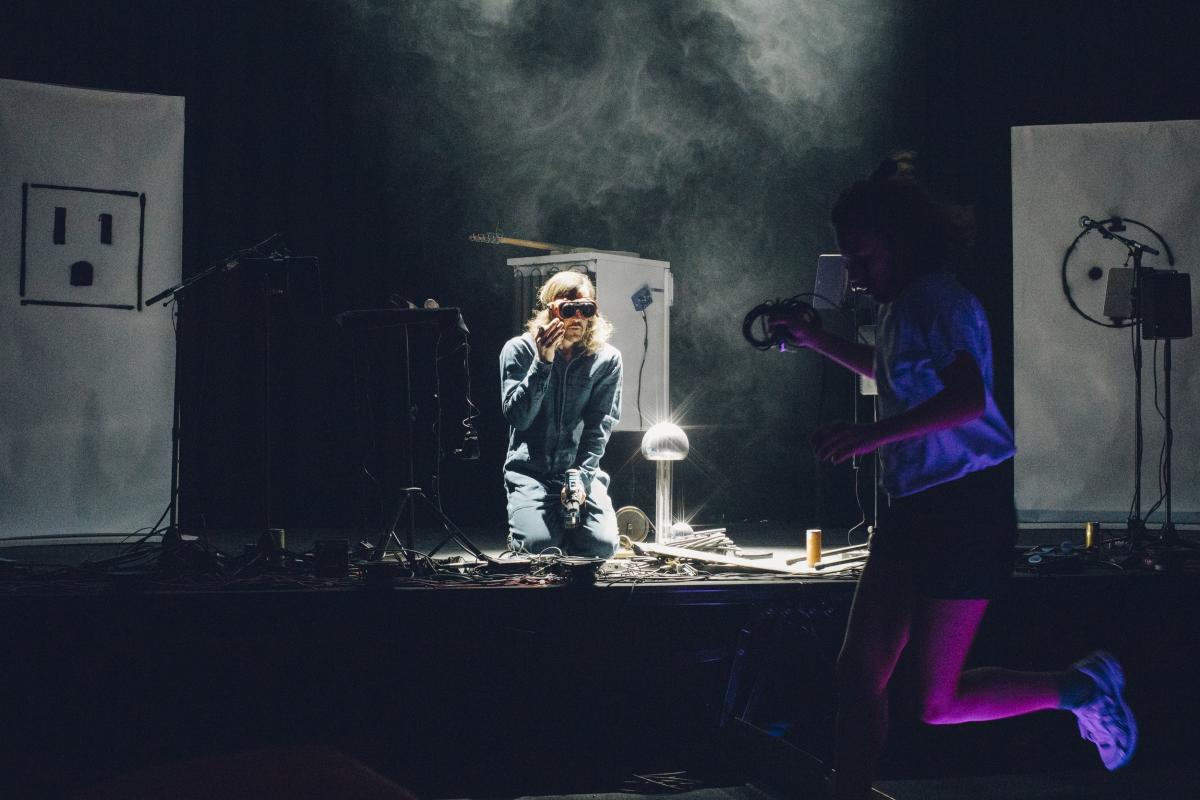
Baptizing a loudspeaker. Worshipping a mini-fridge. A forest crucifixion gone wrong. Standing in awe before a sound amplifier. A room filled with suspended, dismembered guitars. These experiences lie at the center of this artistic research thesis. Combining anthropology, religious studies, and my practice as a composer of music theater, I explore how electronic music devices (the electric guitar, amplifier, and loudspeaker) embody a paradox. Mass-produced consumer products that function as musical instruments, they carry rich symbolic associations with myth, ritual, and the sacred while remaining inseparable from the profane world of tools. Through two new concepts—Symbolic Sound-Producing Gestures and Grotesque Numinosity—I examine how performers’ interactions with technology create sacred meaning in performances that embrace both awe and absurdity, finding intensity where sacred and profane fuse in the raw energy of electronic sound.
1. Le Refuge des Cordes
Installation/performance, 17.6.–12.7.2020
Solo performance with six suspended electric monochords and electronics. Premiered at the gallery Forum Box, Helsinki (FI) during Immortal’s Birthday, an exhibition created in collaboration with artist and researcher Maija Tammi.
2. Electric Unconscious
Staged concert, Black Box, Musiikkitalo, Helsinki (FI) 30.–31.10.2023
For electric guitar, flute, alto saxophone, mini-fridge, and electronics. Co-created with and performed by kollektiv international totem
3. Loudspeaker Baptism
Chamber opera in four acts, Aleksanterin Teatteri, Helsinki (FI) during Oopperakesä Festival 30.–31.8.2024
For soprano, accordion, Genelec 8020D, puppeteer, and electronics. Co-created with and performed by Sawtooth Duo (Sarah Albu and Matti Pulkki)
Abstract of the thesis
This artistic research thesis investigates how music performance with electronic music devices, such as the loudspeaker, electric guitar, and amplifier connects to ideas of the sacred. It combines theories from anthropology, religious studies, musicology, and the history of technology with my artistic practice as a composer.
In my research, I introduce a new concept of Symbolic Sound-Producing Gestures, inspired by composer Mauricio Kagel’s instrumental theater. This concept serves as a compositional tool for shaping symbolic meanings that emerge from the physical interaction between performers and instruments. C. G. Jung’s symbolic framework and Antonin Artaud’s vision of theatrical gestures as powerful symbolic forces guided my exploration of sacred symbolism in the instruments, sounds, and expanded techniques used in my works.
I draw on sociologist Émile Durkheim’s sacred/profane dichotomy, Erik Davis’s book Techgnosis, and consumer researcher Russell W. Belk’s theory of Sacred Consumption to examine the paradoxical entanglement of the sacred and the profane in contemporary consumer culture. In this context, although electronic music devices are inseparable from the profane world of tools and consumption objects, they remain rich in sacred associations because of their long history and diverse cultural manifestations. Moreover, through their capacity to channel vast amounts of energy, they can evoke the emotional intensity of the numinous: awe, dread, and mystery.
I analyze three of my artistic works that exemplify how the staging and use of electronic music devices in music performance can articulate the entanglement of the sacred and the profane. These artistic processes ultimately led me to the concept I call Grotesque Numinosity: an aesthetic lens that embraces both awe and absurdity, finding intense experiences where the sacred and the profane fuse in the raw energy of electronic sound.
Charles Quevillon
Charles Quevillon (b. 1989) is a Canadian-Finnish composer and performer based in Helsinki. His work focuses on the physical dimensions of musical performance, often extending sound-making into dance, theatre, and circus. A significant part of his career has been shaped by his long-standing collaboration with choreographer Tedd Robinson, resulting in twenty-seven dance works and culminating in his first opera in 2016, Love and Other Things. He has developed a distinct compositional approach and collaborated with international music ensembles such as defunensemble (FI), Sound Initiative (FR), Sawtooth (CA), and kollektiv international totem (CH). His second opera, Loudspeaker Baptism (2024), was noted for its “ideal balance between formal innovation and emotional depth.”
More information
Charles Quevillon
charles.quevillon@uniarts.fi
Responsible supervisor of the degree
Prof. Jan Schacher, Sibelius Academy, University of the Arts Helsinki
The panel which assessed the artistic demonstrations
- Prof. Dr. Otso Aavanranta (chair), Research Institute, University of the Arts Helsinki
- Dr. Teemu Mäki – Docent in Artistic Research, Research Institute, University of the Arts Helsinki
- Dr. Milla Tiainen – Senior Lecturer in Musicology, University of Turku
- Hanna Hartman – Composer, Sound Artist and Performer based in Berlin
Examiners of the thesis
- Prof. Dr. Otso Aavanranta (chair), Research Institute, University of the Arts Helsinki
- Dr. Juan Parra Cancino, Orpheus Institute, Ghent, Belgium
- Dr. Michael Eigtved, Associate Professor, Department of Arts and Cultural Studies, University of Copenhagen
- Dr. Teemu Mäki, Docent in Artistic Research, Research Institute, University of the Arts Helsinki
Programme
Opening of the public examination
Lectio praecursoria
Statement of the written component
Discussion
Audience questions
Final Statements
Closing of the public examination
Artistic components of the degree
Baptizing a loudspeaker. Worshipping a mini-fridge. A forest crucifixion gone wrong. Standing in awe before a sound amplifier. A room filled with suspended, dismembered guitars. These experiences lie at the center of this artistic research thesis. Combining anthropology, religious studies, and my practice as a composer of music theater, I explore how electronic music devices (the electric guitar, amplifier, and loudspeaker) embody a paradox. Mass-produced consumer products that function as musical instruments, they carry rich symbolic associations with myth, ritual, and the sacred while remaining inseparable from the profane world of tools. Through two new concepts—Symbolic Sound-Producing Gestures and Grotesque Numinosity—I examine how performers’ interactions with technology create sacred meaning in performances that embrace both awe and absurdity, finding intensity where sacred and profane fuse in the raw energy of electronic sound.
1. Le Refuge des Cordes
Installation/performance, 17.6.–12.7.2020
Solo performance with six suspended electric monochords and electronics. Premiered at the gallery Forum Box, Helsinki (FI) during Immortal’s Birthday, an exhibition created in collaboration with artist and researcher Maija Tammi.
2. Electric Unconscious
Staged concert, Black Box, Musiikkitalo, Helsinki (FI) 30.–31.10.2023
For electric guitar, flute, alto saxophone, mini-fridge, and electronics. Co-created with and performed by kollektiv international totem
3. Loudspeaker Baptism
Chamber opera in four acts, Aleksanterin Teatteri, Helsinki (FI) during Oopperakesä Festival 30.–31.8.2024
For soprano, accordion, Genelec 8020D, puppeteer, and electronics. Co-created with and performed by Sawtooth Duo (Sarah Albu and Matti Pulkki)
Abstract of the thesis
This artistic research thesis investigates how music performance with electronic music devices, such as the loudspeaker, electric guitar, and amplifier connects to ideas of the sacred. It combines theories from anthropology, religious studies, musicology, and the history of technology with my artistic practice as a composer.
In my research, I introduce a new concept of Symbolic Sound-Producing Gestures, inspired by composer Mauricio Kagel’s instrumental theater. This concept serves as a compositional tool for shaping symbolic meanings that emerge from the physical interaction between performers and instruments. C. G. Jung’s symbolic framework and Antonin Artaud’s vision of theatrical gestures as powerful symbolic forces guided my exploration of sacred symbolism in the instruments, sounds, and expanded techniques used in my works.
I draw on sociologist Émile Durkheim’s sacred/profane dichotomy, Erik Davis’s book Techgnosis, and consumer researcher Russell W. Belk’s theory of Sacred Consumption to examine the paradoxical entanglement of the sacred and the profane in contemporary consumer culture. In this context, although electronic music devices are inseparable from the profane world of tools and consumption objects, they remain rich in sacred associations because of their long history and diverse cultural manifestations. Moreover, through their capacity to channel vast amounts of energy, they can evoke the emotional intensity of the numinous: awe, dread, and mystery.
I analyze three of my artistic works that exemplify how the staging and use of electronic music devices in music performance can articulate the entanglement of the sacred and the profane. These artistic processes ultimately led me to the concept I call Grotesque Numinosity: an aesthetic lens that embraces both awe and absurdity, finding intense experiences where the sacred and the profane fuse in the raw energy of electronic sound.
Charles Quevillon
Charles Quevillon (b. 1989) is a Canadian-Finnish composer and performer based in Helsinki. His work focuses on the physical dimensions of musical performance, often extending sound-making into dance, theatre, and circus. A significant part of his career has been shaped by his long-standing collaboration with choreographer Tedd Robinson, resulting in twenty-seven dance works and culminating in his first opera in 2016, Love and Other Things. He has developed a distinct compositional approach and collaborated with international music ensembles such as defunensemble (FI), Sound Initiative (FR), Sawtooth (CA), and kollektiv international totem (CH). His second opera, Loudspeaker Baptism (2024), was noted for its “ideal balance between formal innovation and emotional depth.”
More information
Charles Quevillon
charles.quevillon@uniarts.fi