


A new perspective on Selim Palmgren’s symbolist world
Pianist Henrik Järvi’s recording explores resonance, improvisatory style and inner space.
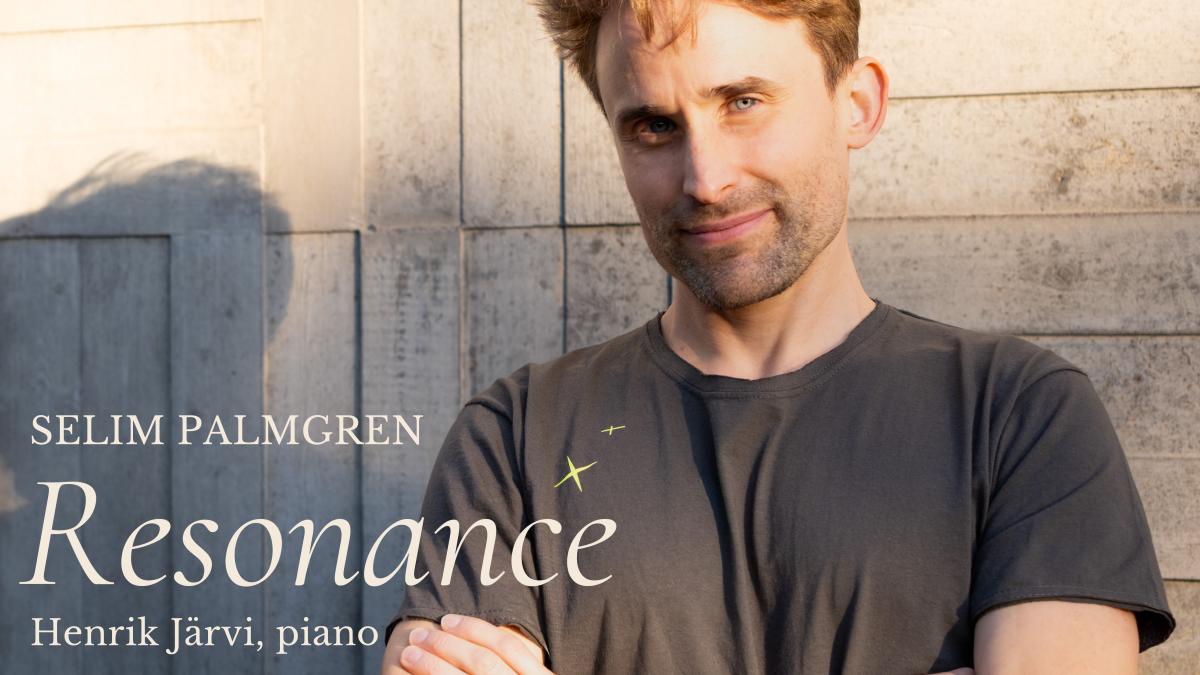
SibaRecords, the record label of the Sibelius Academy at the University of the Arts Helsinki, has released Henrik Järvi’s recording Selim Palmgren – Resonance. The album approaches Palmgren as a composer whose music unfolds through resonance, inner space and performative time.
Selim Palmgren (1878–1951) is widely regarded as a pioneer of Finnish piano music, yet the Symbolist inwardness, improvisatory style and performative freedom of his music have often remained overlooked. This recording offers a new perspective on Palmgren by bringing together rarely performed works. The programme traces a path from the Symbolist inwardness of the early works through the improvisatory freedom of the 1920s and ultimately to the clarified expression of the late style.
“Palmgren has often been described as an Impressionist, but for me his music opens up primarily through Symbolism, resonance and the freedom that emerges in performance,” says Järvi.
“I wanted to create a programme in which Palmgren’s music gradually reveals itself from within. At the same time, the listener can follow the different stages of his development as a composer.”
Symbolism and Inner Space
Night, water, memories, shadows and subtle transitions recur throughout Palmgren’s music. Rather than depicting the external world in a realistic manner, his works create atmospheres and inner spaces that linger momentarily in the listener’s imagination.
The recording also highlights Palmgren’s connections to the art of his time. His music echoes the Symbolist landscapes of Torsten Wasastjerna and Ellen Thesleff, as well as the poetry of K. A. Tavaststjerna and Heinrich Heine.
According to Järvi, it is precisely this Symbolist perspective that reveals a side of Palmgren’s music that has largely remained overlooked in Finland.
Palmgren and the European Tradition
Although Palmgren is often regarded primarily as a national composer, his artistic outlook was firmly rooted in European traditions. Among his teachers in Helsinki were Henryk Melcer-Szczawiński, Walter Petzet and Karl Ekman. He later continued his studies with Ferruccio Busoni in Weimar and Berlin.
For Busoni, a composition was not a fixed object but a living idea that could take different forms in arrangements, revisions and performances. According to Järvi, the same principle lies at the heart of Palmgren’s music: a work is not a finished answer but a point of departure for new interpretations.
The album concludes with Franz Liszt’s Invocation, returning Palmgren to the Romantic composer-performer tradition in which music was understood as an open and continually evolving artistic act.
“Palmgren is not merely a historical figure or a Finnish curiosity. His music continues to speak to us through its sensitivity, its sense of breath, and its ability to leave something unresolved and open,” says Järvi.
Henrik Järvi is currently completing an artistic doctoral degree at the Sibelius Academy, on the piano music of Selim Palmgren. His research explores Palmgren’s music through the concepts of resonance, improvisatory style and performative time. Read more on Henrik Järvi’s homepage
Credits
- Henrik Järvi, piano
- Recorded at Järvenpää Hall, Finland, 1–2 December 2025
- Recording, editing and mastering: Enno Mäemets
- Artistic producer: Viive Mäemets
- Piano technician: Matti Kyllönen
- Photography: Nils Sandman
- SibaRecords production: Pauli Raitakari
- SibaRecords SRDG-1034, EAN 6430037170430. ℗ & © 2026 SibaRecords
About SibaRecords
SibaRecords is the record label of the Sibelius Academy at the University of the Arts Helsinki. Since 2009, it has sought to make visible and audible the diverse musical knowledge of its community. Its releases feature students, teachers and researchers engaged with a wide range of artistic and scholarly questions.
Further information
Pauli Raitakari
pauli.raitakari@uniarts.fi