


Finnish Doctoral Network for Music Research (MuToVe)
We coordinate a network of universities promoting multidisciplinary research.
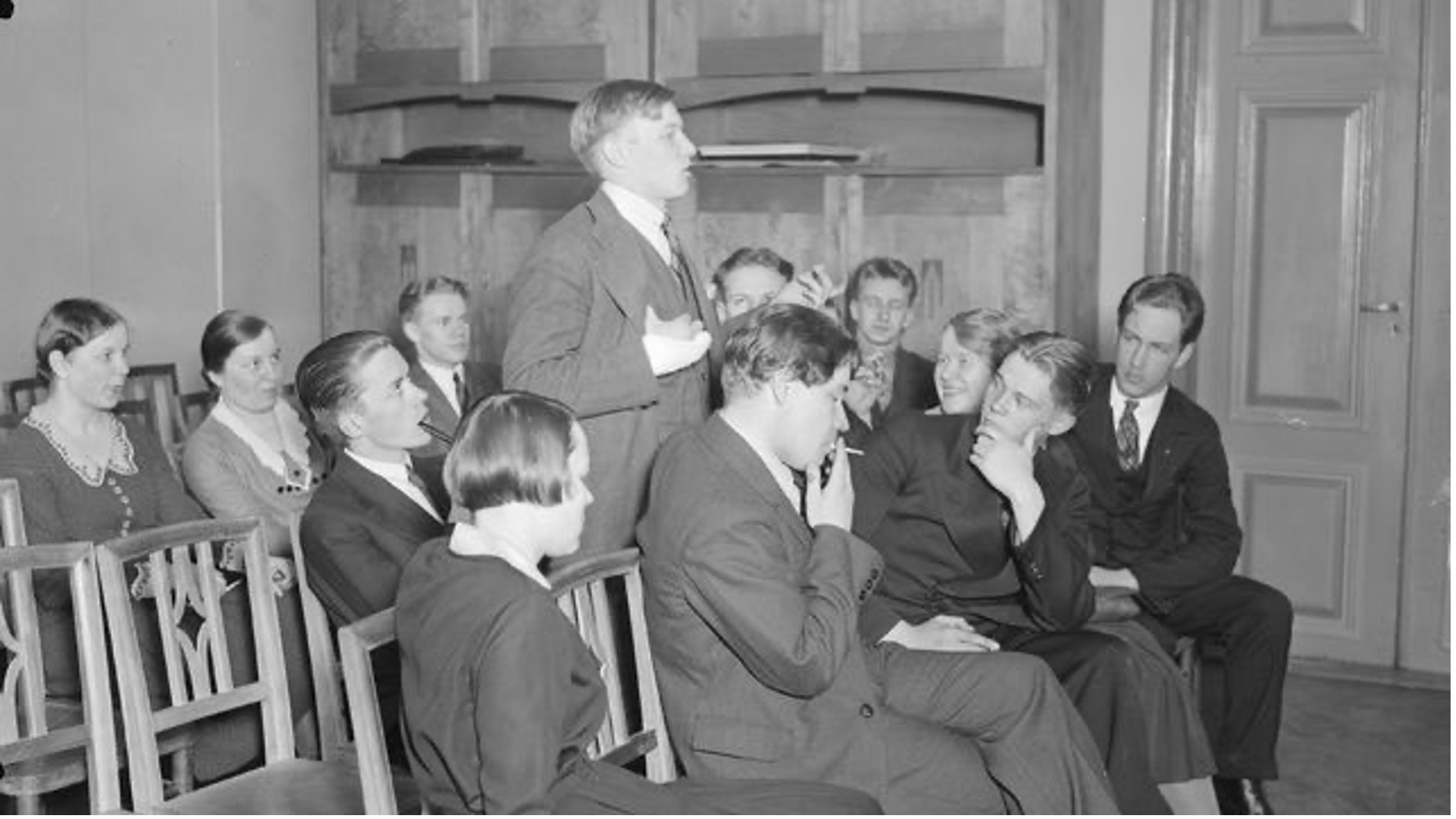
The network upholds the legacy of the Doctoral Programme in Music Research, which was discontinued at the end of 2015. It aims to support national multidisciplinary research on music and the surrounding cultural reality. Doctoral students who are part of the network are pursuing doctoral studies at one of the network’s partner universities. There are no doctoral student positions available in the network itself.
Uniarts Helsinki’s History Forum, which coordinates the network, organises an annual event for doctoral candidates in Finland. The date and arrangements are determined with consideration to other music research events. The event announcement is published on the network’s email list muto@lists.uniarts.fi.
History
Doctoral schools and programmes in music and performing arts have engaged in network-based cooperation for decades since the 1990s with funding from the Ministry of Education and Culture and the Research Council of Finland (formerly Academy of Finland). The goal has been to respond to doctoral students’ educational needs in a way that complements the selection of the network’s partner universities.
The doctoral education network combined the research and artistic angle in music and performing arts research. In artistic research, the ideal was an artist conducting research or a researcher creating art, whose work blended theoretical knowledge and mastery of research methods with an understanding of music and performing arts acquired through personal creative activities.
The network’s researchers who had a scholarly focus had a theoretical approach to art-making. The dialogue between students and supervisors with either an artistic or research orientation was excellent, resulting in original insights in the arts and in research.
Doctoral education networks in music and performing arts have analysed history and culture, and artistic activities have served as a way to produce knowledge and, more traditionally, as the object of research.
The whole network has gathered at least once but usually several times per year, and various working groups have their own activities around specific issues.
Doctoral candidates have been supported through the first draft days, which is an event that prepares them for their doctoral defence. During the first decades, funding was allocated to promote paid doctoral positions, conference trips abroad and study and archive trips. Grants were also available for paying expenses related to proofreading, supervision trips and material collection trips.
The first network was launched in 1995, when VEST, a national doctoral school for performing arts, was launched. The research focus was on performance. The activities involved musicology and theatre research departments, and they were coordinated by the Sibelius Academy. Performing arts was considered to entail music, theatre, dance and opera, which are all connected by the simultaneous presence of the performing person and the audience. The common thread was the multilayered interplay between artistic and scholarly approaches in the activities. Research topics often dealt with bodily experience and the performing artists’ activities, institutional frameworks linked to artistic activities and the cultural significance of the interaction between the aforementioned elements and the audience.
In 2003, another doctoral school alongside VEST was launched, namely Kamupop that focused on folk music and popular music. Its activities were organised by the Sibelius Academy’s Department of Folk Music and Tampere University’s ethnomusicology department, with the Sibelius Academy as the coordinator. The focus was on the Finnish history of folk music and popular music and how its sounds were interpreted.
Both doctoral schools had a strong emphasis on an artist-driven approach, with performance and history research at the forefront. In 2007, they merged into one doctoral school, and a full-time coordinator was hired for five years to support the organising of the executive group’s work. Apart from the University of Oulu and the University of Lapland, all Finnish universities offering music research and/or theatre research were involved.
In 2011, the doctoral programme application round entailed two schools:
- TahTO, coordinated by the Theatre Academy (led by Esa Kirkkopelto) – focus on artistic research
- MuTo, coordinated by the Sibelius Academy (led by Vesa Kurkela) – music research in the broad sense
The Ministry of Education withdrew this funding the next year, in 2012. The seven universities that were involved in the activities for a few years made up for the lack of funding with the help of their own doctoral students and by allocating some funding for coordination expenses. Since then, MuToVe activities have been fully funded by Uniarts Helsinki’s Sibelius Academy. Its focus has been on multidisciplinary research on music and the surrounding cultural reality from a purely scholarly perspective or through interaction with artistic activities.
Activities
Over the years, doctoral schools and programmes have organised various national and international seminars and symposia. The below list only includes recurring, more or less regular activities.
MuToVe winter/autumn school
The Finnish Doctoral Network for Music Research has been organising an annual two- or three-day autumn or winter school every year. All doctoral candidates who have an interest in music research and are affiliated with Finnish universities are eligible to attend. The application period takes place in the spring as regards the autumn school, and in the autumn as regards the winter school. Decisions on attendees are made by the network’s executive group.
The winter school is an informal, seminar-like event, where the doctoral candidates have a chance to present one (sub)chapter, article or a similar text (max. 20 pages) related to their doctoral projects and get feedback from other participants. Professors, university teachers and researchers from Finnish universities take part in the winter school, and participants have the possibility of organising one-to-one supervision meetings with them. Typically, the programme also includes guest lectures on music research.
If you have any questions about the winter school, please contact the network coordinator (marianne.mieskolainen@uniarts.fi).
First draft days
The Finnish Doctoral Network for Music Research arranges so-called first draft days for its members in collaboration with Finnish universities. The first draft day is meant as a feedback session for a doctoral candidate who wants to receive comments on their thesis before submitting it for preliminary examination.
Each first draft day has an assigned commentator who thoroughly reads the thesis manuscript beforehand and presents questions on it during the event. Typically, there is also a possibility for other network members to attend and ask questions. However, the event’s openness and level of formality can be adjusted according to the doctoral candidate’s wishes.
First draft days usually take place around the network’s yearly winter/autumn school dates, although they can be arranged at other times as well. If you are interested in this feedback opportunity, please contact your supervisor and the network coordinator (marianne.mieskolainen@uniarts.fi) well in advance. All first draft day opponents are paid a fee for commenting and attending.
Study groups
The Finnish Doctoral Network for Music Research has several study groups that each have focused on specific questions or areas of interest. The aim is to relaunch the activities as widely as possible once the funding situation has improved.
The study groups have convened in seminars on a regular basis to discuss assigned research articles or the attendees’ research reports. Some of the groups also convene online.
Article workshop
This group has been part of the course selection at the Sibelius Academy, but it welcomes all university students and postdoctoral researchers who are planning to write a research article for an academic publication, regardless of their home base. The methodological focus is on music history research. Participants examine research articles, practise constructive criticism of the peers’ texts and write a research article to be published in, for example, the Musiikki journal. The group has been led by Professor Anne Kauppala.
Benjamin group
The Walter Benjamin study group was a place for doctoral students to share their thoughts and views on Benjamin’s texts and to discuss Benjamin’s concept of aura. This group convened in Helsinki.
Gender group
The study group focuses on gender issues in music research. The group has been led by Professor John Richardson and Licentiate of Philosophy (currently Doctor of Philosophy) Anna-Elena Pääkkölä.
Merleau-Ponty group
The study group gathered at the University of Eastern Finland and online during the 2012–13 academic year. The participants discussed a book that was relevant to their work, namely Phenomenology of Perception by Maurice Merleau-Ponty. At each gathering, the study group discussed at least one section of the book, which all participants had read and one of them was assigned to give a presentation on to the rest of the group. The collective goal was to delve deeper into Merleau-Ponty’s ideas.
Methodology group
In the spring of 2013, the group discussed discourse analysis in music research. In the future, the group plans to explore new areas of methodology. The group has been led by Professor Tarja Rautiainen-Keskustalo.
Music and time geography
This group was launched at the University of Eastern Finland and online in the autumn of 2013. The focus was on the questions of time geography and rhythm analysis. The group has been led by Professor Helmi Järviluoma and Master of Philosophy (currently Doctor of Philosophy) Salli Anttonen.
Popular music group
This group’s focus was on the connections between music and society, specifically consumption, media, economy and politics. The majority of the articles that were analysed in this group discussed popular music genres. Despite its name, the group is prepared to tackle research on any aspect of music. The group has been led by Professor Heikki Uimonen and Doctor of Social Sciences Kaarina Kilpiö, both from the Sibelius Academy.
Technology group
The focus was on timbre, questions regarding music technology research and audiovisual themes. The group has been led by Docent Susanna Välimäki and Professor John Richardson.
Travel grants
When funding was available, the doctoral programme supported programme-funded doctoral students in international activities by allocating travel grants. Students could apply for grants of up to 600 euros per year to pay for their conference and seminar trips abroad.
Travel grants could also be awarded to students who studied within the programme but received funding from another source. Criteria for travel grants included an approved presentation for a conference and having the conference trip promote the applicant’s dissertation and researcher career.
Executive group
The network is led by a group of partner representatives. The executive group is chaired by Professor Markus Mantere (markus.mantere@uniarts.fi) from Uniarts Helsinki’s History Forum, which coordinates the network.
Other members of the executive group are
Johannes Brusila, professor (Åbo Akademi University, musicology)
Susanna Välimäki, professor (University of Helsinki, musicology)
Juha Torvinen, docent, university lecturer (University of Helsinki, musicology, deputising for Susanna Välimäki 2025)
Tarja Rautiainen-Keskustalo, professor (Tampere University, Faculty of Information Technology and Communication Sciences)
John Richardson, professor (University of Turku, musicology)
Martin Hartmann, assistant professor (University of Jyväskylä, musicology)
Pekka Suutari, professor (University of Eastern Finland, Karelian Institute)
Kristiina Ilmonen, professor (Uniarts Helsinki’s Sibelius Academy, folk music & MuTri)
Katja Sutela, university lecturer (University of Oulu, early childhood and music education studies)
Links
University-level theses in music in 2024 (compiled by the Finnish Musicological Society)
Contact information
-
Markus Mantere
- Professor, music history, Sibelius-Akatemian tohtoriohjelma, Sibelius Academy
- +358407104339
- markus.mantere@uniarts.fi
-
Marianne Mieskolainen
- Specialist, Tutkimusinstituutti, Research Institute
- marianne.mieskolainen@uniarts.fi
Project name
Finnish Doctoral Network for Music Research (MuToVe)
Collaborators
- Uniarts Helsinki’s History Forum and Sibelius Academy
- University of Helsinki
- University of Eastern Finland
- University of Jyväskylä
- University of Oulu
- Tampere University
- University of Turku
- Åbo Akademi University
Contact
Markus Mantere markus.mantere@uniarts.fi
Marianne Mieskolainen marianne.mieskolainen@uniarts.fi
The doctoral network mainly uses its email list muto@lists.uniarts.fi for communication about its activities.
Request to be added to the email list on the page https://lists.uniarts.fi/listinfo/muto.
You can join the network’s Facebook group here.
The network upholds the legacy of the Doctoral Programme in Music Research, which was discontinued at the end of 2015. It aims to support national multidisciplinary research on music and the surrounding cultural reality. Doctoral students who are part of the network are pursuing doctoral studies at one of the network’s partner universities. There are no doctoral student positions available in the network itself.
Uniarts Helsinki’s History Forum, which coordinates the network, organises an annual event for doctoral candidates in Finland. The date and arrangements are determined with consideration to other music research events. The event announcement is published on the network’s email list muto@lists.uniarts.fi.
History
Doctoral schools and programmes in music and performing arts have engaged in network-based cooperation for decades since the 1990s with funding from the Ministry of Education and Culture and the Research Council of Finland (formerly Academy of Finland). The goal has been to respond to doctoral students’ educational needs in a way that complements the selection of the network’s partner universities.
The doctoral education network combined the research and artistic angle in music and performing arts research. In artistic research, the ideal was an artist conducting research or a researcher creating art, whose work blended theoretical knowledge and mastery of research methods with an understanding of music and performing arts acquired through personal creative activities.
The network’s researchers who had a scholarly focus had a theoretical approach to art-making. The dialogue between students and supervisors with either an artistic or research orientation was excellent, resulting in original insights in the arts and in research.
Doctoral education networks in music and performing arts have analysed history and culture, and artistic activities have served as a way to produce knowledge and, more traditionally, as the object of research.
The whole network has gathered at least once but usually several times per year, and various working groups have their own activities around specific issues.
Doctoral candidates have been supported through the first draft days, which is an event that prepares them for their doctoral defence. During the first decades, funding was allocated to promote paid doctoral positions, conference trips abroad and study and archive trips. Grants were also available for paying expenses related to proofreading, supervision trips and material collection trips.
The first network was launched in 1995, when VEST, a national doctoral school for performing arts, was launched. The research focus was on performance. The activities involved musicology and theatre research departments, and they were coordinated by the Sibelius Academy. Performing arts was considered to entail music, theatre, dance and opera, which are all connected by the simultaneous presence of the performing person and the audience. The common thread was the multilayered interplay between artistic and scholarly approaches in the activities. Research topics often dealt with bodily experience and the performing artists’ activities, institutional frameworks linked to artistic activities and the cultural significance of the interaction between the aforementioned elements and the audience.
In 2003, another doctoral school alongside VEST was launched, namely Kamupop that focused on folk music and popular music. Its activities were organised by the Sibelius Academy’s Department of Folk Music and Tampere University’s ethnomusicology department, with the Sibelius Academy as the coordinator. The focus was on the Finnish history of folk music and popular music and how its sounds were interpreted.
Both doctoral schools had a strong emphasis on an artist-driven approach, with performance and history research at the forefront. In 2007, they merged into one doctoral school, and a full-time coordinator was hired for five years to support the organising of the executive group’s work. Apart from the University of Oulu and the University of Lapland, all Finnish universities offering music research and/or theatre research were involved.
In 2011, the doctoral programme application round entailed two schools:
- TahTO, coordinated by the Theatre Academy (led by Esa Kirkkopelto) – focus on artistic research
- MuTo, coordinated by the Sibelius Academy (led by Vesa Kurkela) – music research in the broad sense
The Ministry of Education withdrew this funding the next year, in 2012. The seven universities that were involved in the activities for a few years made up for the lack of funding with the help of their own doctoral students and by allocating some funding for coordination expenses. Since then, MuToVe activities have been fully funded by Uniarts Helsinki’s Sibelius Academy. Its focus has been on multidisciplinary research on music and the surrounding cultural reality from a purely scholarly perspective or through interaction with artistic activities.
Activities
Over the years, doctoral schools and programmes have organised various national and international seminars and symposia. The below list only includes recurring, more or less regular activities.
MuToVe winter/autumn school
The Finnish Doctoral Network for Music Research has been organising an annual two- or three-day autumn or winter school every year. All doctoral candidates who have an interest in music research and are affiliated with Finnish universities are eligible to attend. The application period takes place in the spring as regards the autumn school, and in the autumn as regards the winter school. Decisions on attendees are made by the network’s executive group.
The winter school is an informal, seminar-like event, where the doctoral candidates have a chance to present one (sub)chapter, article or a similar text (max. 20 pages) related to their doctoral projects and get feedback from other participants. Professors, university teachers and researchers from Finnish universities take part in the winter school, and participants have the possibility of organising one-to-one supervision meetings with them. Typically, the programme also includes guest lectures on music research.
If you have any questions about the winter school, please contact the network coordinator (marianne.mieskolainen@uniarts.fi).
First draft days
The Finnish Doctoral Network for Music Research arranges so-called first draft days for its members in collaboration with Finnish universities. The first draft day is meant as a feedback session for a doctoral candidate who wants to receive comments on their thesis before submitting it for preliminary examination.
Each first draft day has an assigned commentator who thoroughly reads the thesis manuscript beforehand and presents questions on it during the event. Typically, there is also a possibility for other network members to attend and ask questions. However, the event’s openness and level of formality can be adjusted according to the doctoral candidate’s wishes.
First draft days usually take place around the network’s yearly winter/autumn school dates, although they can be arranged at other times as well. If you are interested in this feedback opportunity, please contact your supervisor and the network coordinator (marianne.mieskolainen@uniarts.fi) well in advance. All first draft day opponents are paid a fee for commenting and attending.
Study groups
The Finnish Doctoral Network for Music Research has several study groups that each have focused on specific questions or areas of interest. The aim is to relaunch the activities as widely as possible once the funding situation has improved.
The study groups have convened in seminars on a regular basis to discuss assigned research articles or the attendees’ research reports. Some of the groups also convene online.
Article workshop
This group has been part of the course selection at the Sibelius Academy, but it welcomes all university students and postdoctoral researchers who are planning to write a research article for an academic publication, regardless of their home base. The methodological focus is on music history research. Participants examine research articles, practise constructive criticism of the peers’ texts and write a research article to be published in, for example, the Musiikki journal. The group has been led by Professor Anne Kauppala.
Benjamin group
The Walter Benjamin study group was a place for doctoral students to share their thoughts and views on Benjamin’s texts and to discuss Benjamin’s concept of aura. This group convened in Helsinki.
Gender group
The study group focuses on gender issues in music research. The group has been led by Professor John Richardson and Licentiate of Philosophy (currently Doctor of Philosophy) Anna-Elena Pääkkölä.
Merleau-Ponty group
The study group gathered at the University of Eastern Finland and online during the 2012–13 academic year. The participants discussed a book that was relevant to their work, namely Phenomenology of Perception by Maurice Merleau-Ponty. At each gathering, the study group discussed at least one section of the book, which all participants had read and one of them was assigned to give a presentation on to the rest of the group. The collective goal was to delve deeper into Merleau-Ponty’s ideas.
Methodology group
In the spring of 2013, the group discussed discourse analysis in music research. In the future, the group plans to explore new areas of methodology. The group has been led by Professor Tarja Rautiainen-Keskustalo.
Music and time geography
This group was launched at the University of Eastern Finland and online in the autumn of 2013. The focus was on the questions of time geography and rhythm analysis. The group has been led by Professor Helmi Järviluoma and Master of Philosophy (currently Doctor of Philosophy) Salli Anttonen.
Popular music group
This group’s focus was on the connections between music and society, specifically consumption, media, economy and politics. The majority of the articles that were analysed in this group discussed popular music genres. Despite its name, the group is prepared to tackle research on any aspect of music. The group has been led by Professor Heikki Uimonen and Doctor of Social Sciences Kaarina Kilpiö, both from the Sibelius Academy.
Technology group
The focus was on timbre, questions regarding music technology research and audiovisual themes. The group has been led by Docent Susanna Välimäki and Professor John Richardson.
Travel grants
When funding was available, the doctoral programme supported programme-funded doctoral students in international activities by allocating travel grants. Students could apply for grants of up to 600 euros per year to pay for their conference and seminar trips abroad.
Travel grants could also be awarded to students who studied within the programme but received funding from another source. Criteria for travel grants included an approved presentation for a conference and having the conference trip promote the applicant’s dissertation and researcher career.
Executive group
The network is led by a group of partner representatives. The executive group is chaired by Professor Markus Mantere (markus.mantere@uniarts.fi) from Uniarts Helsinki’s History Forum, which coordinates the network.
Other members of the executive group are
Johannes Brusila, professor (Åbo Akademi University, musicology)
Susanna Välimäki, professor (University of Helsinki, musicology)
Juha Torvinen, docent, university lecturer (University of Helsinki, musicology, deputising for Susanna Välimäki 2025)
Tarja Rautiainen-Keskustalo, professor (Tampere University, Faculty of Information Technology and Communication Sciences)
John Richardson, professor (University of Turku, musicology)
Martin Hartmann, assistant professor (University of Jyväskylä, musicology)
Pekka Suutari, professor (University of Eastern Finland, Karelian Institute)
Kristiina Ilmonen, professor (Uniarts Helsinki’s Sibelius Academy, folk music & MuTri)
Katja Sutela, university lecturer (University of Oulu, early childhood and music education studies)
Links
University-level theses in music in 2024 (compiled by the Finnish Musicological Society)
Contact information
-
Markus Mantere
- Professor, music history, Sibelius-Akatemian tohtoriohjelma, Sibelius Academy
- +358407104339
- markus.mantere@uniarts.fi
-
Marianne Mieskolainen
- Specialist, Tutkimusinstituutti, Research Institute
- marianne.mieskolainen@uniarts.fi