


UNESCO heritage inscription changes local politics
A study from Uniarts Helsinki shows that UNESCO Intangible Cultural Heritage inscription reshaped local political debates, municipal strategies and public investments, turning cultural heritage into a resource all political parties sought to use, regardless of their previous attitudes toward cultural funding.
Kaustinen fiddle playing and related practices and expressions was inscribed on UNESCO’s Representative List of the Intangible Cultural Heritage of Humanity in 2021. Researchers Outi Valo and Heidi Henriikka Mäkelä from the University of the Arts Helsinki examined how the UNESCO inscription affected municipal politics in Kaustinen, political discourse, and investments related to culture and heritage.
Valo and Mäkelä analysed the minutes of the Kaustinen Municipal Council and Kaustinen Municipal Executive from 2016 to 2023, as well as reporting in the local newspaper Perhonjokilaakso concerning the same decisions and debates.
Cuts to cultural funding as a starting point
Before the local associations in Kaustinen decided to pursue international UNESCO inscription for its living heritage, both of the municipality’s main political parties, the Centre Party and the Finns Party, proposed cuts to the cultural sector.
The Finns Party in particular repeatedly called for reductions in support for the Folk Art Centre and in funding for Pro Kaustinen and the Finnish Folk Music Institute.
“Kaustinen folk arts activities are often associated with a national, middle-class or highly local identity. One might expect these characteristics to appeal particularly to the Finns Party, yet its municipal election candidates did not place them at the forefront of their political messaging before the 2017 elections,” says Folk Music Lecturer Heidi Henriikka Mäkelä from the Uniarts Helsinki’s Sibelius Academy.
According to Valo and Mäkelä, one possible explanation is the long and close relationship between the Centre Party and the Kaustinen Folk Music Festival. For the Finns Party, it was politically important to distinguish itself from the Centre Party rather than promote the same priorities in local politics.
“In Sweden, the populist Sweden Democrats, a party often compared to the Finns Party, have supported Swedish local folk music at the national level and called for increased public funding for it instead of multicultural programmes.”
The UNESCO process increased the significance of heritage in municipal politics
According to the study, during the UNESCO nomination process and especially after the inscription, heritage came to be viewed in municipal decision-making not as an expense, but as a resource for local vitality, place branding, tourism and future development.
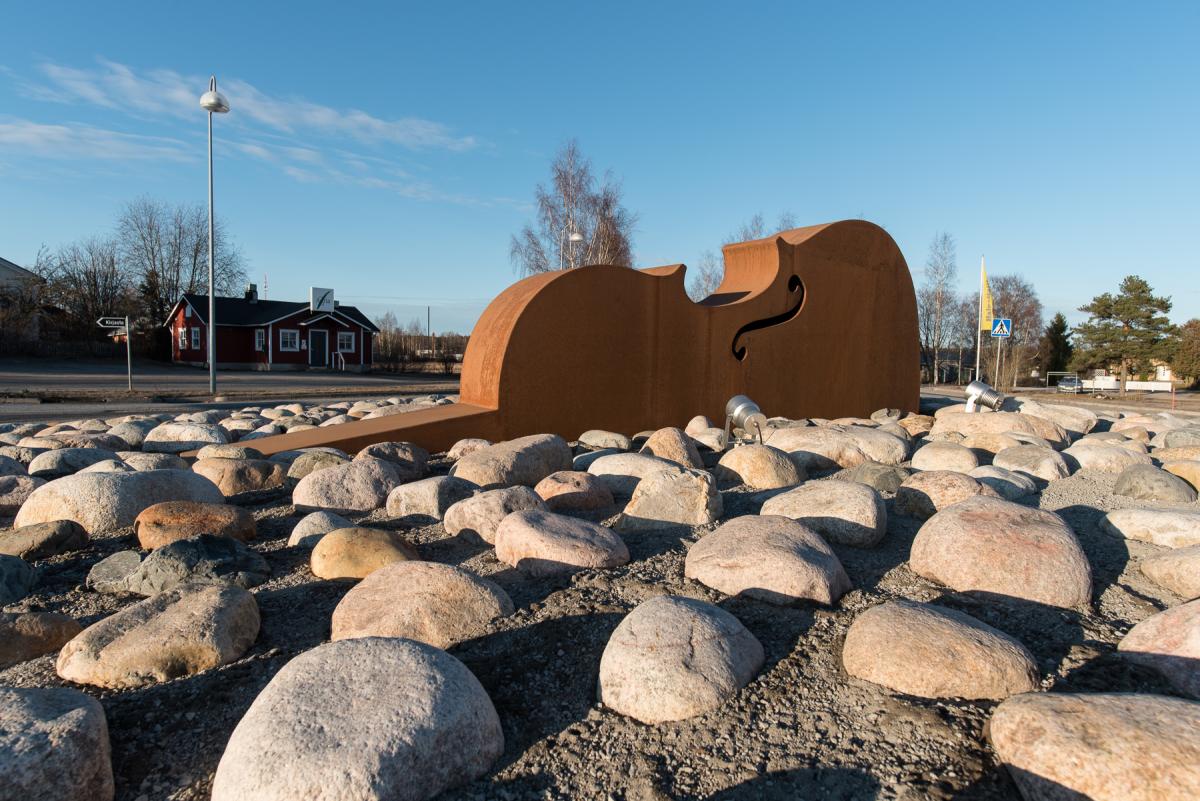
The researchers describe how discussions related to intangible cultural heritage gradually began to influence both the language used by politicians and even the municipality’s built environment. According to Valo and Mäkelä, the large violin-shaped sculpture installed in a roundabout is a tangible manifestation of heritage-related values and of municipal decision-making that shapes the community’s everyday life and living environment.
In 2018, the concept of“living heritage” was included in the municipality’s strategy for the first time. Thereafter, the term appeared repeatedly in municipal strategies, budgets, annual reports, and tourism and cultural development plans.
“In contrast, the term ‘intangible cultural heritage’ was used very rarely. We interpret this as indicating that ‘living heritage’ was an easier, more positive and more future-oriented concept for politicians to embrace,” Valo says.
All political parties began to make use of the UNESCO status
Whereas before the UNESCO process the Finns Party had been the most eager advocate of cuts to cultural funding, after the inscription it began referring to UNESCO recognition in municipal decision-making. Party representatives even proposed that every child born in Kaustinen should receive a violin gifted by the municipality.
According to the researchers, this demonstrates that the symbolic value associated with UNESCO recognition was quickly recognised even by politicians who had previously shown little interest in cultural heritage.
Attitudes towards funding remained unchanged
Although the importance of heritage increased, attitudes towards its costs remained contradictory.
The researchers found that politicians were keen to use UNESCO status in place branding, tourism promotion and municipal marketing. At the same time, investments and maintenance costs continued to generate opposition. Funding for the Folk Art Centre in particular remained a recurring source of conflict.
The study shows that heritage became a tool in local power struggles and political competition.
“UNESCO recognition gave Kaustinen fiddle playing a symbolic value that every political party wanted to utilise in one way or another. Even parties that had previously opposed cultural funding can adopt heritage-based rhetoric once the value of the UNESCO brand is recognised,” Valo concludes.