


Dean Kaisa Rönkkö believes in the power of curiosity and responsible freedom
Rönkkö began her term as Dean of the Sibelius Academy in January 2026. We asked her about her views on, among other things, community relations, leadership, and tensions.
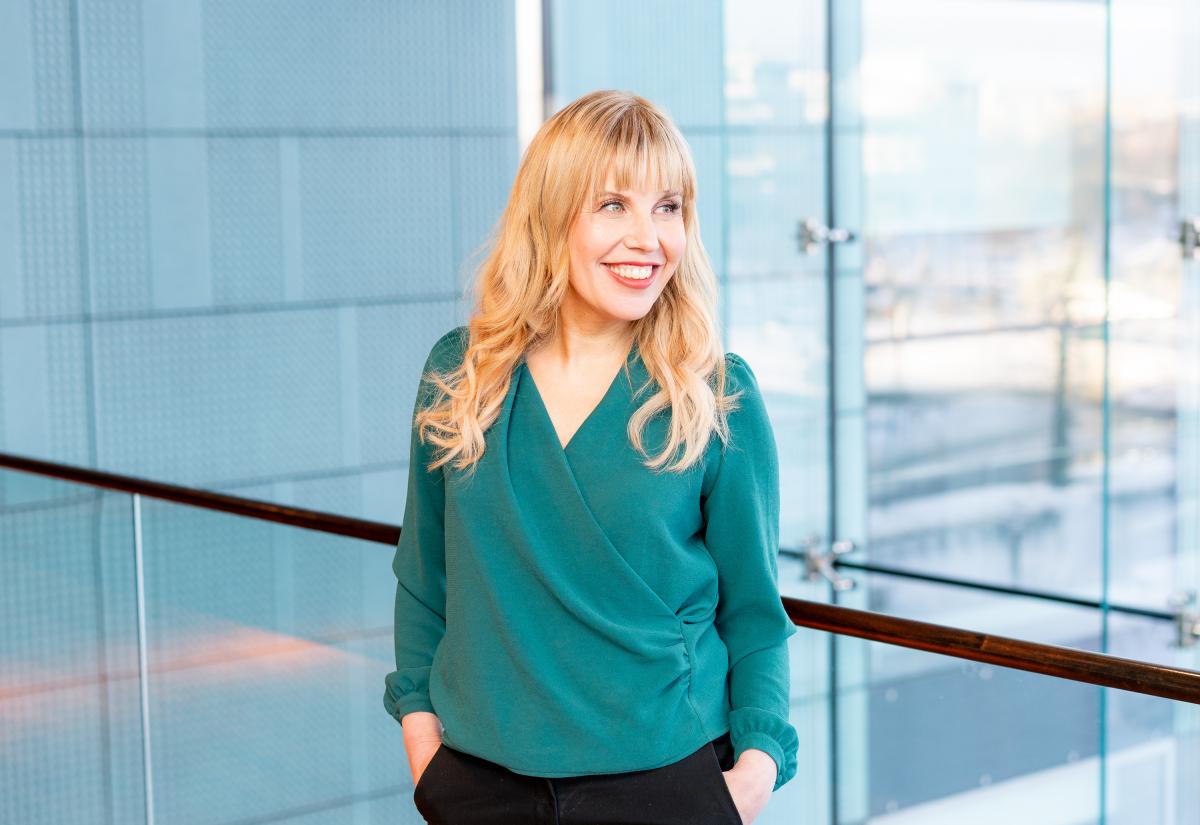
Kaisa Rönkkö emphasises that art is always created in interaction with the surrounding society. For that reason, the Sibelius Academy must remain in close dialogue with its environment – both as an educational institution and as an active commenter and influencer in society.
The Dean feels she has joined a community that has a solid foundation. At the same time, the world around us is changing, and leadership must evolve with it.
“My duty is to create space and to act as a kind of interpreter between the language of bureaucracy, society and the arts, and to remind us of what this is all really about: the art itself.”
As society becomes more diverse, Rönkkö feels it is important to reflect on whom the Sibelius Academy’s activities reach and from what backgrounds people come to the Sibelius Academy. For this reason, societal engagement, impact, and active dialogue with the surrounding society are central to her work.
“We educate music teachers, international conductors, church musicians and top-level soloists. Here you can really see and sense the chain of generations through which we reach out to society at large in a truly unique way. Our activities are broadly and internationally connected with society and musical life, ranging from game music to music education in primary schools and various professional practices in the field. Research constitutes a cross-cutting dimension that permeates this entire whole.”
She wants the Sibelius Academy to educate artists and pedagogical experts who are both bold and realistic: professionals who understand how the arts sector operates beyond the university walls. However, building external relations requires deliberate effort.
“My task is to ensure that what we do at the Sibelius Academy is socially impactful and novel – something that hasn’t been done or heard before – and that it’s easy to express its significance in words and actions and show proof of it.”
Rönkkö also stresses the importance of valuing high-quality instruction in music instruments, pedagogical skills and artistic craftsmanship. These form the core of the Sibelius Academy and its appeal.
“Skill lies at the heart of art-making. That is something we cannot and must not compromise on, even as the world changes. Teaching is not about shielding students from reality, but helping them navigate within it. That is why our connection to the professional field cannot be limited to individual courses. It must be a natural part of the student’s entire academic path.”
Freedom requires structure and entails responsibility
For Rönkkö, freedom means the ability to operate in a world that is not always fair or without limits. To be sustainable, freedom requires structure and responsibility. Artistic freedom can be a space, guided by wisdom, in which curiosity, skill and tensions can generate something new.
“We have a responsibility to help students understand that when working professionally, there are structures that set certain boundaries. Complete freedom may sound wonderful, but it often leads to chaos. Freedom that is guided by wisdom creates space for new ideas and curiosity. We must also encourage students to be curious and bold.”
In fact, Rönkkö finds curiosity vital for both art and research. She finds it important to ask if the current education system allows enough space for students to stray from the standard path and to experiment and have meaningful interactions.
“Curiosity is fragile and cannot be forced on anyone. It requires time, space and structures that enable it. When it thrives, it fuels everything else. I don’t believe in fearmongering or patronising, but if curiosity is important to us, we must build it into our structures.”
Tensions as a force in art
The world is full of tensions and polarities. Rönkkö believes they are also part of the essence of art: tensions are woven into the history of art, where the new always emerges in dialogue with the old and through the clashes of opposing forces. For that reason, tensions should not be removed or “resolved away.”
“If we had no tensions, it would actually pose a great threat to artistic freedom. It would suggest that we have become one-voiced. And the world simply isn’t like that.”
One of the key tensions in the arts sector concerns the relationship between freedom and structure. Rönkkö suggests that tensions should be made visible: they are not a disturbance but a resource.
The arts sector sometimes tends to romanticise conflict as part of artistic expression. Rönkkö notes that leaders should not fall into this trap.
“In the arts, it is often assumed that tensions are part of the package. Yet we must be able to discuss them calmly, openly and in everyday terms. Wise management of tensions means enabling dialogue and clarifying the shared direction: the organisation must have a common vision and shared values. Without these, tensions cannot be constructive.”
Wise leadership, then, does not pursue harmonious unanimity but sustainable diversity.
“What matters is whether we have the ability to articulate our various tensions and face them. Given the right push, this process can lead to something new and exciting.”
Who is Kaisa Rönkkö?
- Dean of Uniarts Helsinki’s Sibelius Academy during the term from 1 January 2026 to 31 December 2030
- Former director of the Arts Promotion Centre Finland (Taike), executive director of Music Finland, head of the Orchestral Department at the Finnish National Opera and Ballet, and senior specialist at the Finnish Defence Forces
- Has also worked as a CEO, manager, musician, pedagogue and developer of creative industries
- Teaches piano to students of various ages
- Became inspired by the diversity and power of music at a young age through the Up with People organisation