


Learning from the best in the field – a donation to the Theatre Academy made a special masterclass possible
The Theatre Academy was able to organise a chamber play masterclass thanks to a generous donation. One of the plays written by students will go straight to a professional theatre stage.
Next year, Theatre Academy students are expected to complete around ten new chamber plays. At least one of these is guaranteed to premiere at a professional theatre, Teatteri Jurkka in Helsinki.
The creation of these new plays was made possible by a €150,000 donation from three private individuals who wish to remain anonymous, and by the chamber play masterclass organised with the university’s donation funds.
“I am so happy and proud of this course and immensely grateful to the donors. This could never have been possible without them,” says Heini Junkkaala, professor of dramaturgy and playwriting.
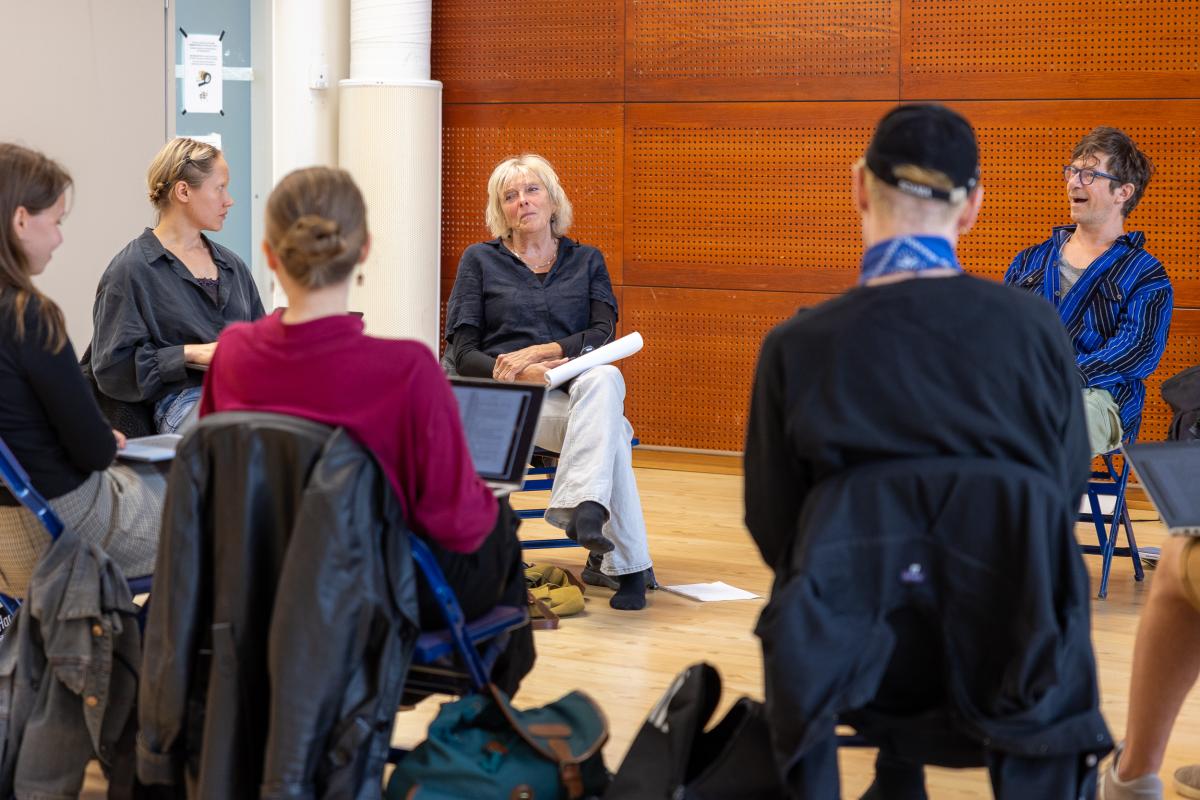
The masterclass was held in the autumn and attended by 12 students. It was led by a top professional in the field, Swedish playwright Mia Törnqvist.
Two more similar masterclasses will be organised with donation funds. Next autumn’s theme will be children’s plays, and in autumn 2027, the theme will be musical theatre. These courses will also feature renowned playwrights from around the world as teachers.
The donors specifically wanted to support theatre studies. They have been impressed by how theatre can tell deeply meaningful stories on stage using relatively simple means.
Plays for professional stages
“Mia was a very straightforward, even demanding teacher. She didn’t let any sloppy work pass her by. The assignments were clear, and you got the feeling that she really knows what she’s talking about,” describes Fabian Silén, who took the masterclass.
He says he internalised the idea that before starting to write, you need to know the subject of the play well, and that a chamber play script contains everything necessary; it is not modified further on stage.
On the course, students read classics aloud together: plays by Minna Canth, Henrik Ibsen and August Strindberg. Every now and then Törnqvist interrupted the reading to ask, “Why did the character say that?” or “What does this mean?”
Each student wrote one scene during the course, for which they received personal feedback from Törnqvist. The scenes came to life when professional actors performed them in workshops. There, students got to see how their own text worked.
“After each performed scene, Mia asked the students what happened on stage. A simple question reveals to the writer how the audience understands the scene,” Junkkaala explains.
On the last day of the course, the actors performed the students’ polished scenes once more.
If they wish, students can complete their plays and receive guidance for their work. According to Junkkaala, most of the course participants have seized this opportunity. Fabian Silén also plans to finish his play, if time allows.
Teatteri Jurkka has promised to select one of the plays for production. The premiere will be in December 2026. Other theatres have also shown interest in the new texts.
“It’s absolutely wonderful that young writers get to collaborate with professional theatres already during their studies,” Junkkaala says happily.
Theatre needs new Finnish plays
Chamber plays, children’s plays, as well as musical plays and musicals were deliberately chosen as the themes for the masterclasses.
“A chamber play is a great way to study the most fundamental aspects of playwriting: how to build dramatic tension and how to evoke the questions you want in the audience,” Junkkaala says.
In an intimate play with a few characters and a short time span, the tension largely relies on the gradual revelation of information – how it slowly becomes clear what dramatic events have previously happened to the characters.
Children’s plays and musical plays were chosen as separate courses because there have not been enough premieres of these genres recently in Finland.
“The reason for including musical plays and musicals was also that we want to increase collaboration between academies within Uniarts Helsinki. We hope to get composition students from the Sibelius Academy involved, too,” Junkkaala explains. In autumn 2026, a new master’s programme in musical theatre will start at Uniarts Helsinki, combining the Sibelius Academy’s music education and the Theatre Academy’s performing arts education.
Junkkaala emphasises that Finnish premieres are crucial to the vitality of Finnish theatre. It is important that people in Finland also address issues that are unique to them.
“In times of polarisation, Finnish theatre has an especially important role. A play is an exercise in empathy. The writer, actor and audience each take turns stepping into someone else’s shoes. Theatre brings different voices and perspectives to the stage.”
According to the professor, the plays being created can, in their own small way, help compensate for cuts affecting theatre, as tightening budgets mean fewer premieres.
Ultimately, it is about the vitality and future of theatre. New plays reflect the worldview of a younger generation of writers. Young audiences need theatre that speaks about their world.
Text: Anu Vallinkoski